News india Gaganyaan In Final Leg: ISRO Plans First Uncrewed Space Mission Within Four MonthsGaganyaan In Final Leg: ISRO Plans First Uncrewed Space Mission Within Four Months
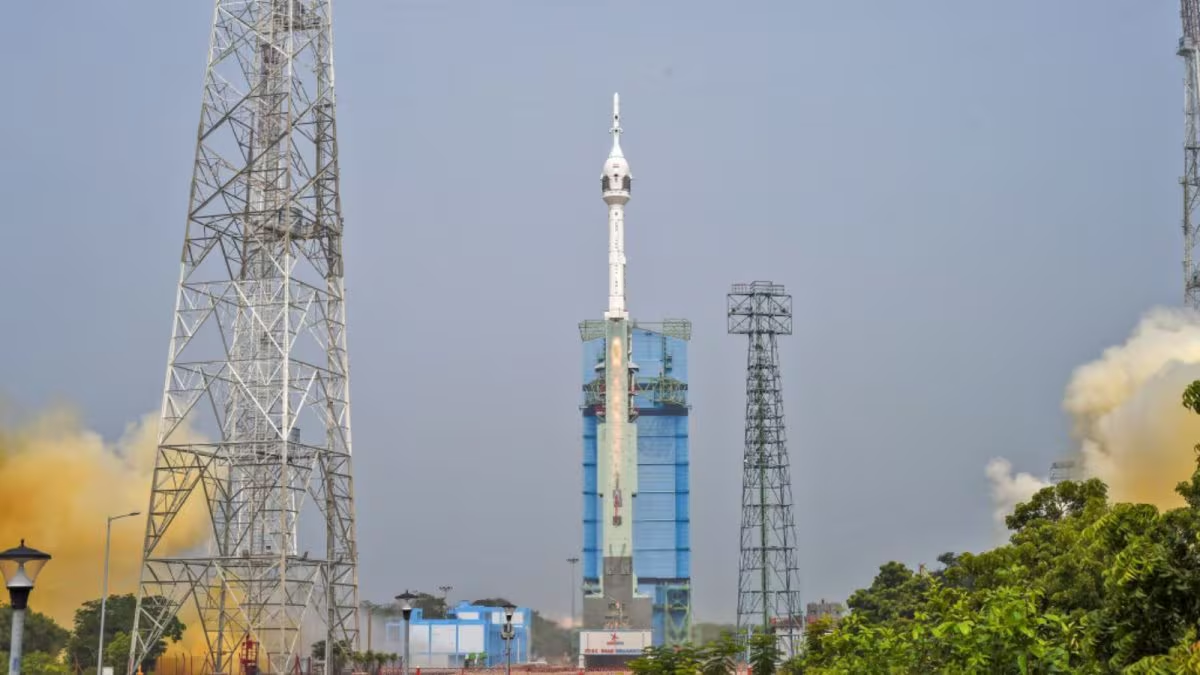
Gaganyaan is one of India’s most complex technological programmes, requiring a human-rated launch vehicle, crew module, life-support systems and a safe return for astronauts.
To support manned missions, ISRO is planning to build a strong, secure, and highly reliable communication network. (Representational Image: PTI)
India’s space programme is set for a packed year, with ISRO planning eight launch vehicle missions and 12 satellite missions during the current financial year. The first uncrewed Gaganyaan mission is among the biggest milestones on the schedule.
The plan comes as ISRO works to strengthen its launch capabilities and prepare for India’s human spaceflight programme. After a year in which the space agency is yet to record a successful launch, ISRO Chairman Dr V Narayanan said the first uncrewed Gaganyaan mission is expected within the next four months.
Gaganyaan Enters Final Stage
Speaking at the Third National Space Day celebrations in Ahmedabad, Narayanan said around 8,000 tests had been completed for Gaganyaan.
“We are in the final leg," he said, adding that three uncrewed missions would be carried out before the crewed mission.
An uncrewed mission will simulate a human spaceflight without astronauts inside the spacecraft. It is intended to test how the rocket and spacecraft perform without putting human lives at risk.
Gaganyaan is one of India’s most complex technological programmes, requiring a human-rated launch vehicle, crew module, life-support systems and a safe return for astronauts. The programme is seen as a step towards a permanent Indian presence in space.
Eight Launches, 12 Satellites Planned
Narayanan said ISRO plans to realise 12 satellites and conduct eight launch vehicle missions during the current financial year.
The missions are expected to support communication, navigation, Earth observation and scientific research, while also helping prepare for future human spaceflight and exploration programmes.
However, the Polar Satellite Launch Vehicle (PSLV) remains grounded by the government, pending several ground tests after two consecutive failures of the rocket.
Narayanan said India’s space needs have expanded sharply. While the country currently has 56 space assets after 64 years of its space programme, he said it needs at least 200 to 300 satellites within five years.
He said such a target could not be achieved by the government sector alone and would require greater participation from private companies and start-ups.
440 Space Start-ups Now In India
Narayanan credited the space sector reforms introduced in 2020 with transforming India’s space ecosystem.
India had only a handful of space start-ups when the reforms were announced. The number has now grown to around 440, working in areas including launch vehicles, satellites, applications and advanced technologies.
He also highlighted the successful orbital mission of Skyroot Aerospace’s Vikram 1 rocket, calling it a landmark for private Indian space companies. He credited cooperation between start-ups, ISRO and IN-SPACe for the achievement.
From Sanctions To Indigenous Technology
Narayanan also recalled India’s early space programme, when the country relied on foreign technology and faced technology denials and sanctions from advanced space powers.
He cited indigenous cryogenic technology as an example of India’s transformation. Technology once denied to India now powers launches of sophisticated satellites from Indian soil.
He also highlighted the launch of a six-tonne communications satellite built by an American company using India’s LVM3 rocket into low Earth orbit. According to Narayanan, the mission showed international confidence in Indian capabilities and was secured on commercial merit.
He also pointed to NISAR, the NASA-ISRO Synthetic Aperture Radar mission, describing it as one of the most sophisticated Earth observation satellites built. Indian engineers developed the indigenous payload at 40% of NASA’s cost, while the satellite was jointly conceived, realised and launched by India and the US.
Moon, Venus And Mars On Roadmap
India’s exploration plans include Chandrayaan-4 and Chandrayaan-5, building on Chandrayaan-3. Plans are also under way for a Venus mission and a future Mars landing mission.
Narayanan reiterated the goal of building an Indian space station by 2035 and said India aims to launch more than 300 satellites over the next six to seven years with support from industry and start-ups.
He also recalled Chandrayaan-1’s discovery of water molecules on the Moon, Chandrayaan-3’s historic soft landing near the lunar south pole and Aditya L1 placing India among countries operating dedicated solar observatories.
“A country which started the space programme 64 years back with bicycles and bullock carts," Narayanan said, adding that by 2040, when India lands on the Moon, “India will be second to none".
For now, ISRO’s immediate challenge is the first uncrewed Gaganyaan mission. A successful test would mark an important step towards India’s human spaceflight ambitions.
News18 NewsletterHandpicked stories, in your inboxA newsletter with the best of our journalismsubmit
Key Questions Answered
Powered by Ask News18Could India achieve its space station goal by 2035?
India aims to establish an operational Indian space station by 2035, with the first module of the Bharatiya Antariksh Station planned for launch in 2028. The final five modules are slated for completion by 2035.