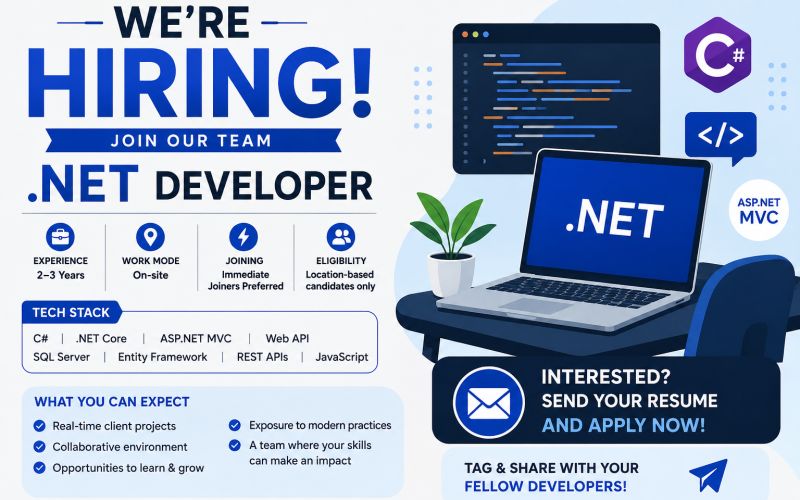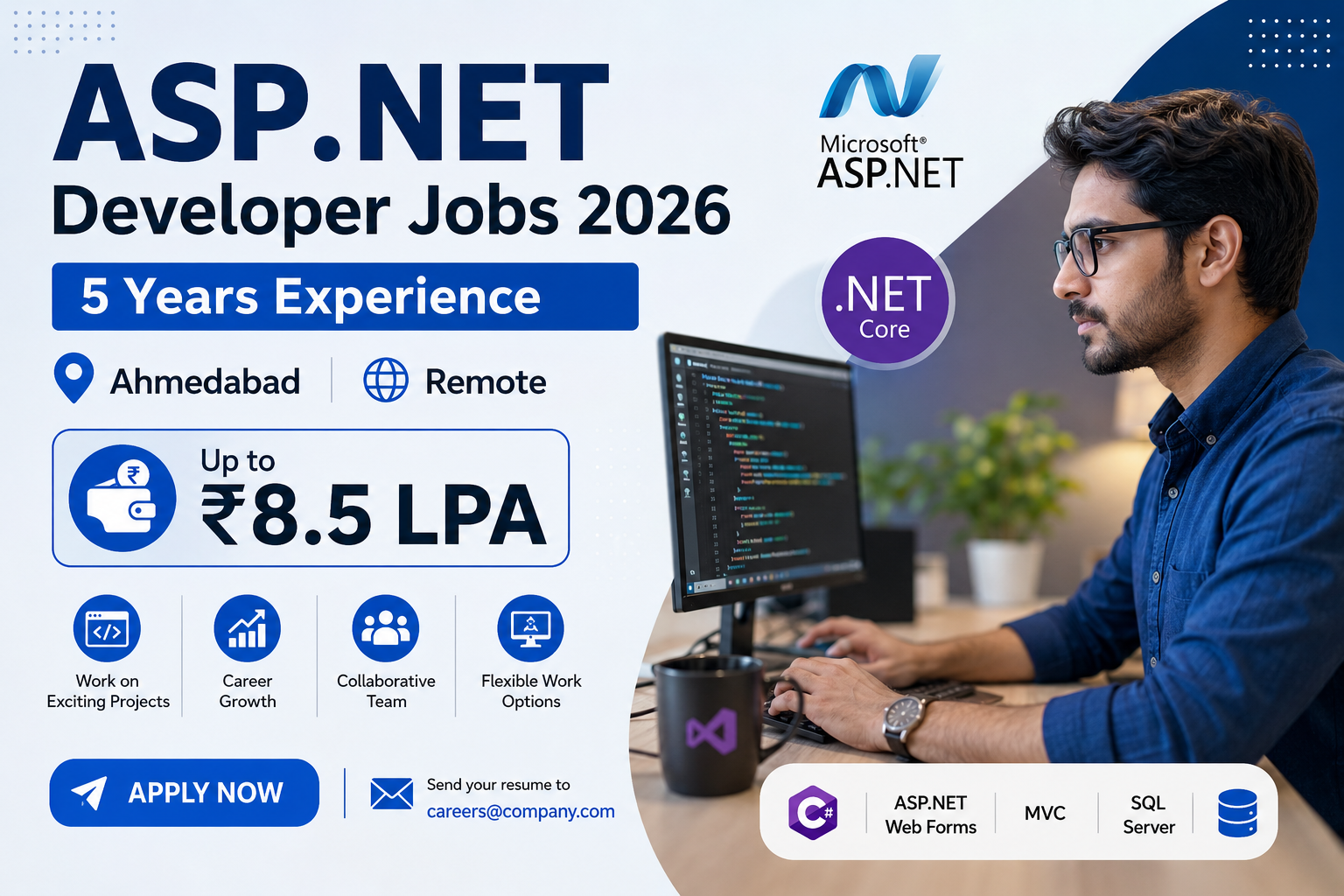
🚀 We're Hiring: ASP.NET Developer (Ahmedabad / Remote Opportunity)
Are you an experienced Microsoft stack professional skilled in architecting enterprise backend systems and scaling database layers? A premier software development agency is searching for a highly skilled and analytical Senior ASP.NET Developer. This premium position offers the flexibility of working from our state-of-the-art office in Ahmedabad, Gujarat, or operating in a 100% remote work-from-home setup. If you have a solid track record of optimization and system building, this is the perfect career milestone for you.
Hiring for Allies Business Hub.
💼 Position Overview:
• Role: ASP.NET Backend Developer
• Experience Required: 5+ Years of professional software development experience
• Job Location: Ahmedabad, Gujarat / Permanent Remote (Work from Home)
• Employment Type: Full-Time, Permanent
• Salary Budget: Up to ₹8,50,000 per annum (Based on expertise)
⚙️ Core Roles & Responsibilities:
As an experienced .NET Developer, your daily technical and architectural tasks will include:
• Designing, coding, testing, and maintaining secure web-based applications using ASP.NET Core and C#.
• Architecting clean, decoupled enterprise systems using robust MVC software design patterns.
• Designing, optimizing, and managing complex relational database structures using Microsoft SQL Server.
• Writing high-performance SQL queries, advanced stored procedures, views, and structural database indexes.
• Creating, standardizing, testing, and integrating secure RESTful Web APIs and microservices.
• Troubleshooting runtime exceptions, tracing memory leaks, and refactoring code to optimize execution latency.
• Collaborating closely with front-end UI engineers, QA automation units, and technical project leads.
📌 Technical Skills & Profile Required:
Candidates applying for this engineering role must possess advanced expertise in:
• Core Programming: Deep technical command over C#.NET programming and object-oriented design (OOPs).
• Framework Mastery: Extensive production environment experience utilizing ASP.NET Core and MVC architectures.
• Database Layer: Solid knowledge of MS SQL Server database modeling, normalization, and execution plan query tuning.
• Data Access Layers: Fluent working implementation track records utilizing Entity Framework Core or LINQ patterns.
• Integration & Deployment: Proven experience standardizing Web API configurations and version control via Git.
• Mentorship Mindset: Ability to audit codebases, maintain system documentation, and guide junior engineering talent.
Across clustered environments like Kubernetes. This architecture isolates application execution layers, handles seamless rolling updates with zero configuration downtime, and auto-scales resource nodes dynamically based on server load spikes.
🎁 Perks & Benefits:
• Remote Flexibility: Complete support for a 100% cloud-based remote home setup with agile digital team collaboration tools.
• Cutting-Edge Tech Stack: Work directly with modern .NET 8/9, enterprise microservices architectures, and cloud-native deployments.
• Balanced Workspace: Access to continuous learning modules, dedicated mentorship, and progressive corporate health frameworks.
📩 How to Apply:
Interested and qualified software developers can share their updated profiles directly using the link below:
📋 Top 10 .NET & SQL Server Interview Questions & Answers (5+ Years Experience)
To assist senior candidates in successfully clearing advanced technical evaluation pipelines, our panel has curated the top technical interview questions with enterprise-grade answers.
Q1. What is the difference between .NET Framework and modern .NET (Core/5/6/7/8+)?
Ans. .NET Framework is a legacy, Windows-only platform used primarily for older systems like Web Forms. Modern .NET is an open-source, cross-platform framework designed to run seamlessly on Windows, Linux, and macOS. It features vastly superior performance matrices, native dependency injection containers, built-in cloud integrations, and is heavily optimized for microservices and container deployments.
Q2. How does the Garbage Collector (GC) handle memory management in .NET?
Ans. The .NET Garbage Collector manages memory allocation dynamically using a generational engine:
• Generation 0: Houses short-lived objects (like local variables created inside loops).
• Generation 1: Acts as a buffer zone for objects surviving initial GC cleanup passes.
• Generation 2: Contains long-lived system layers (like application-wide singletons).
When Generation 0 fills up, a collection cycle triggers to reclaim unused heap blocks, promoting active references to higher generations.
Q3. What is Dependency Injection (DI) service lifetime configuration in .NET Core?
Ans. In ASP.NET Core, internal service lifecycles are configured inside the program build configurations using three scopes:
• Transient: Instantiates a fresh object reference every single time it is requested by components.
• Scoped: Generates a single shared object instance valid throughout the lifecycle of a single HTTP request network loop.
• Singleton: Produces one solitary instance that resides continuously in memory throughout the application runtime.
Q4. How do you optimize database query execution plans inside Microsoft SQL Server?
Ans. Database optimization requires targeting physical storage layouts:
• Implement appropriate Clustered and Non-Clustered Indexes based on runtime query execution profiling.
• Avoid utilizing wildcard operators or structural 'SELECT *' queries; pull only indexed target columns.
• Regularly audit execution plans to track down heavy Table Scans and replace them with precise Index Seeks.
• Utilize Parameterized Queries or stored procedures to block security risks and reuse query execution plans efficiently.
Q5. What is the difference between asynchronous Task returning types and classic synchronous methods?
Ans. Synchronous threads completely halt system thread processing pools while waiting for slow operations like disk files or network card data transfers to finish. Asynchronous execution leveraging the async/await paradigm yields the active thread handle cleanly back to the operating system pool, allowing it to fulfill other requests while background hardware processes complete.
Q6. Explain the operational difference between Clustered and Non-Clustered Indexes in SQL Server.
Ans. A Clustered Index physically re-orders the actual data rows inside the database table based on the key values (e.g., Primary Key), meaning a table can only possess one clustered layout. A Non-Clustered Index builds a distinct logical mapping array separate from the primary data pages, acting like an index list at the back of a textbook to direct traffic quickly.
Q7. What is Entity Framework Core tracking vs. non-tracking execution logic?
Ans. By default, EF Core tracks state modifications on retrieved objects to automatically push runtime updates back to database cells during SaveChanges() loops. Utilizing the .AsNoTracking() expansion modifier bypasses this memory-intensive state-tracking network completely, which provides a massive performance boost for read-only analytical dashboard operations.
Q8. How does global exception capturing handle runtime errors securely in Web APIs?
Ans. Centralized global exception catching is mapped using custom middleware chains or modern Exception Filters. Instead of embedding repetitive try-catch architectures into individual controller routes, unhandled crashes are caught at a higher pipeline level, allowing the app to log full traces internally while returning standardized, sanitized HTTP error blocks to public clients.
Q9. What are the core architectural layout principles governing SOLID programming design?
Ans. SOLID provides a framework pattern blueprint for building highly maintainable systems:
• Single Responsibility: A code class must have only one functional reason to undergo modifications.
• Open/Closed: Software modules must be open for expansion behaviors but closed to core modifications.
• Liskov Substitution: Child types must easily replace base parent structures without crashing execution paths.
• Interface Segregation: Large technical client maps must be broken down into small, highly targeted feature masks.
• Dependency Inversion: Implementations should map cleanly to abstract boundaries rather than hardcoded physical concrete paths.
Q10. How would you handle continuous deployment workflows using container clusters?
Ans. The software deployment strategy shifts towards modern environment packaging routines using Docker toolsets. Code structures are compiled inside lightweight container images that can be systematically deployed and scaled across clustered environments like Kubernetes or Azure Cloud services, ensuring production parameters stay consistent regardless of the underlying operating system.