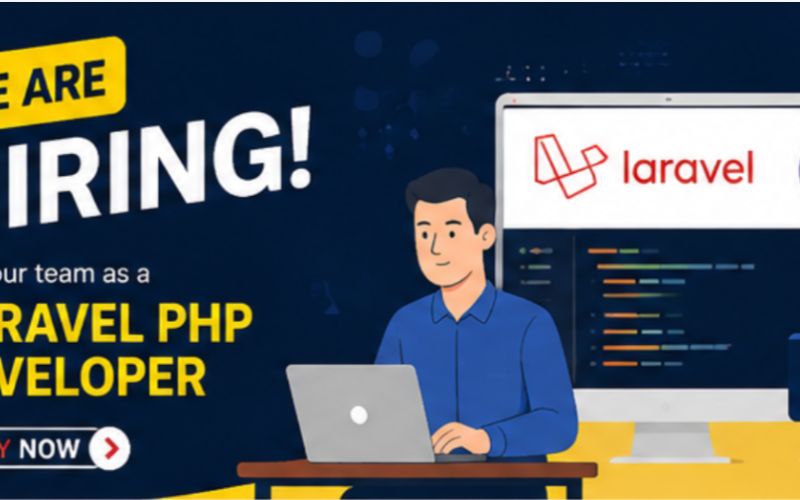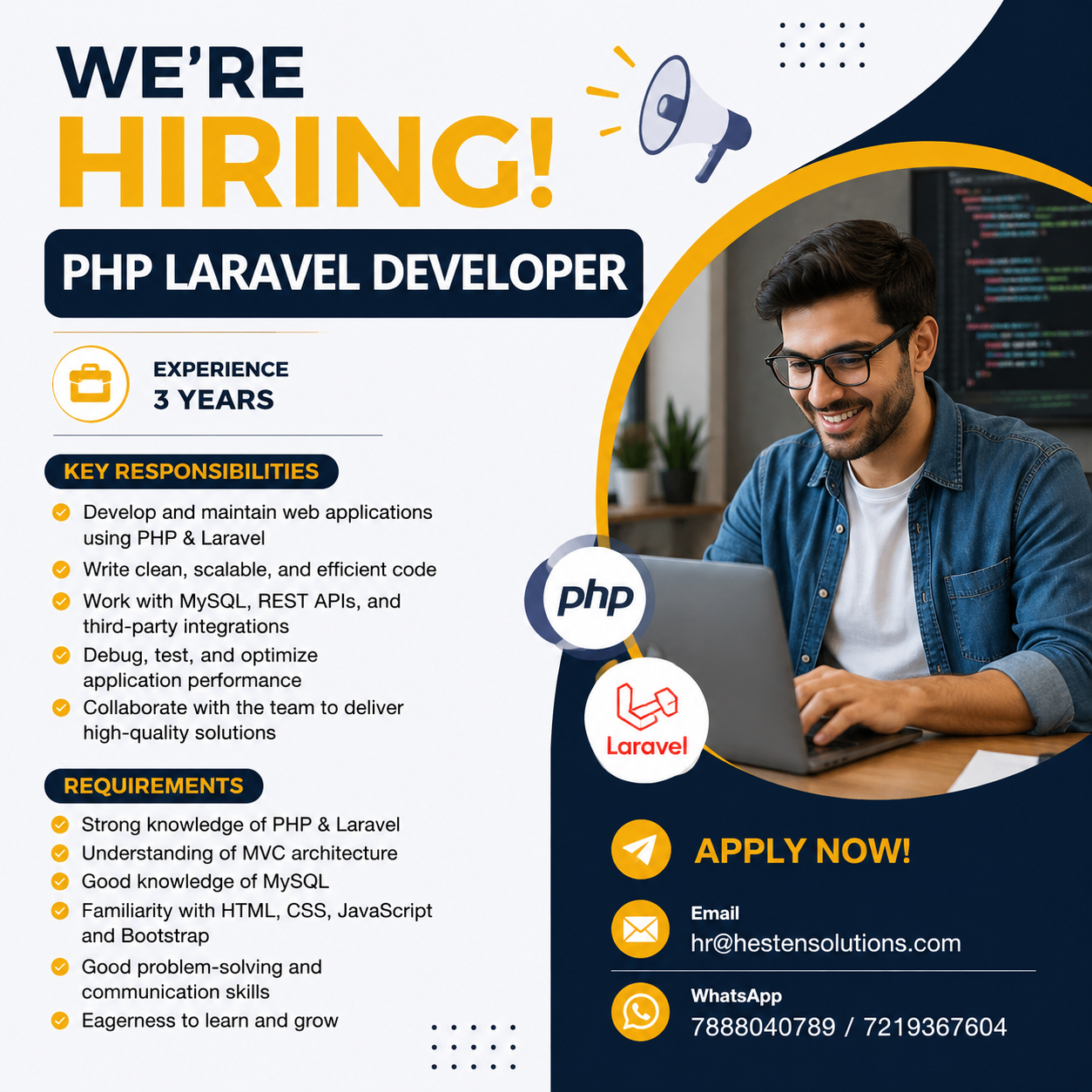
🚀 We're Hiring: PHP Laravel Developer (Fresher to Junior Level)
Are you an aspiring backend developer looking to jumpstart your career by building dynamic, high-performance web applications using modern frameworks? Hexton Solutions is actively searching for a motivated, driven, and enthusiastic PHP Laravel Developer to join our growing in-house engineering team on-site. This entry-to-junior level position is specifically tailored for candidates with 0 to 3 years of experience who possess a strong technical foundation and an eagerness to learn under senior mentorship.
Hiring for Hexton Solutions.
💼 Position Overview:
• Role: PHP Laravel Developer (Junior / Associate Level)
• Experience Required: 0 - 3 Years (Freshers with strong academic project experience can apply)
• Job Location: Industrial Area, Mohali, Punjab (Complete On-Site)
• Employment Type: Full-Time, Permanent
• Salary Range: ₹2,40,000 - ₹4,50,000 Per Annum (Based on machine coding performance)
⚙️ Core Roles & Responsibilities:
As a Junior PHP Laravel Developer at Hexton Solutions, your daily technical and collaborative tasks will include:
• Assisting senior backend engineers in writing clean, structured, and maintainable object-oriented PHP code.
• Developing and updating modular components for web applications using the Laravel framework ecosystem.
• Writing, debugging, and optimizing basic relational database schemas, tables, and standard MySQL queries.
• Building, testing, and documenting internal RESTful APIs for frontend web integration architectures.
• Integrating responsive frontend client-side elements (HTML5, CSS3, Bootstrap) smoothly with backend application logic.
• Troubleshooting minor application bottlenecks, identifying runtime syntax errors, and fixing bugs.
• Participating in daily standalone agile sprint meetings and rapidly adopting new software engineering paradigms.
📌 Eligibility Criteria (Technical Skills Required):
Candidates applying for this entry-level framework role must possess practical familiarity with:
• Backend Core: Fundamental understanding of Core PHP fundamentals, object-oriented programming (OOPs), and the MVC architecture.
• Relational Databases: Basic query building, table structural structures, and relational data handling utilizing MySQL databases.
• Frontend Fundamentals: Good command over standard client-side web languages including HTML5, CSS3, JavaScript, and responsive Bootstrap layouts.
• Version Control Basics: Elementary knowledge of code management pipelines using Git repositories and GitHub versioning workflows.
• Mindset Profile: Excellent logical debugging, analytical thinking, and a high aptitude for continuous technical growth under pressure.
Top 10 PHP Laravel Interview Q&As for Junior Developers (0–3 Years)
Q1. What is the operational purpose of the Service Container inside the Laravel framework?
Ans. The Service Container is a powerful architectural framework container used to manage class dependencies and perform automated dependency injection. Classes define what interfaces they require, and the system resolves and injects them automatically at runtime.
Ans. The Service Container is a powerful architectural framework container used to manage class dependencies and perform automated dependency injection. Classes define what interfaces they require, and the system resolves and injects them automatically at runtime.
Q2. What are Laravel Migrations and why are they highly useful for development teams?
Ans. Migrations act like version control for your database, allowing engineers to programmatically define, alter, and deploy relational database table schemas using structured PHP code scripts instead of executing raw manual SQL files.
Ans. Migrations act like version control for your database, allowing engineers to programmatically define, alter, and deploy relational database table schemas using structured PHP code scripts instead of executing raw manual SQL files.
Q3. How do you validate form data in Laravel and show the errors on the page?
Ans. Inside the controller you call $request->validate() with rules for each field, for example 'email' => 'required|email' and 'phone' => 'required|digits:10'. If validation fails, Laravel automatically sends the user back to the form with the old input and the error messages. In the Blade view, @error('email') ... @enderror shows the message under the correct field, and old('email') refills what the user had typed.
Q4. What is Middleware in Laravel, and what is its primary execution purpose?
Ans. Middleware represents specialized interceptor code chains injected into the application's routing pipeline. They validate, alter, or block incoming HTTP requests before they reach core controller actions (e.g., executing user authentication validation checks or setting up global CORS rules).
Ans. Middleware represents specialized interceptor code chains injected into the application's routing pipeline. They validate, alter, or block incoming HTTP requests before they reach core controller actions (e.g., executing user authentication validation checks or setting up global CORS rules).
Q5. What is the purpose of the CSRF token wrapper inside Laravel theme form layouts?
Ans. The @csrf blade helper directive generates a unique cryptographically secure token checked against user sessions during submission. This validation pattern completely blocks malicious third-party cross-site request forgery attacks targeting application endpoints.
Ans. The @csrf blade helper directive generates a unique cryptographically secure token checked against user sessions during submission. This validation pattern completely blocks malicious third-party cross-site request forgery attacks targeting application endpoints.
Q6. What is Composer, and why does every Laravel project need it?
Ans. Composer is the dependency manager for PHP. The composer.json file lists the packages a project needs, including Laravel itself. Running "composer install" downloads them into the vendor folder. Composer also generates the autoloader, so classes load automatically without manual require statements. For a fresher, the most important rule is to never edit files inside vendor, because the next composer update overwrites them.
Q7. How do you pass dynamic variable arrays from a routing file into a Blade template view layout?
Ans. Variables are injected into blade parameters using the native view() function paired with either the with() chain helper or the standard compact() reference token payload configuration block. Example: return view('jobs.index', compact('jobs')).
Ans. Variables are injected into blade parameters using the native view() function paired with either the with() chain helper or the standard compact() reference token payload configuration block. Example: return view('jobs.index', compact('jobs')).
Q8. What are Laravel Seeders and Database Factories used for?
Ans. Seeders are technical utility modules used to populate database cells programmatically with static data configuration templates. Factories use advanced faker libraries to automate the bulk generation of millions of rows of dummy records for rapid machine runtime performance testing.
Ans. Seeders are technical utility modules used to populate database cells programmatically with static data configuration templates. Factories use advanced faker libraries to automate the bulk generation of millions of rows of dummy records for rapid machine runtime performance testing.
Q9. What does "php artisan storage:link" do?
Ans. Files uploaded by users, such as resumes or profile photos, are saved in storage/app/public, a folder the browser cannot reach directly. "php artisan storage:link" creates a shortcut called public/storage that points to that folder, so the files can be shown on the website with asset('storage/filename.jpg'). It is a common step that gets missed when moving a project to a new server, and the usual reason uploaded images suddenly stop showing.
Q10. How do you handle application runtime configuration data safely inside a Laravel framework?
Ans. All environment variables, API secret access keys, and system database passwords must be stored securely inside the root directory
Ans. All environment variables, API secret access keys, and system database passwords must be stored securely inside the root directory
.env configuration file, which should never be pushed to public source control systems like GitHub.📋 Selection & Interview Process:
• Phase 1: Technical CV Evaluation – Screening candidates based on core project complexity, Git profiles, and framework exposure.
• Phase 2: Fundamental Programming Test – A short machine coding assignment to analyze basic PHP logic, array manipulation, and MySQL structures.
• Phase 3: Technical Interview Panel – A deep-dive face-to-face or virtual conversation assessing MVC fundamentals, routing parameters, and web loops.
• Phase 4: HR Validation Round – Final discussion regarding workplace onboarding rules, cultural alignments, and CTC structures.
🎁 Perks & Benefits:
• Fast-Track Appraisals: Quarterly performance evaluations and rapid skill acceleration roadmaps.
• Professional Mentorship: Direct interaction, learning blueprints, and architectural training supervised directly by senior tech leads.
• Vibrant Tech Environment: Work within a welcoming, highly collaborative, and technically progressive corporate office workspace.
📩 How to Apply:
Know a talented fresher or junior developer looking to secure a full-time PHP Laravel job? Share this amazing entry-level career opportunity with them!