🚀 We're Hiring: Senior .NET UWP Developer (Hybrid Role in Pune)
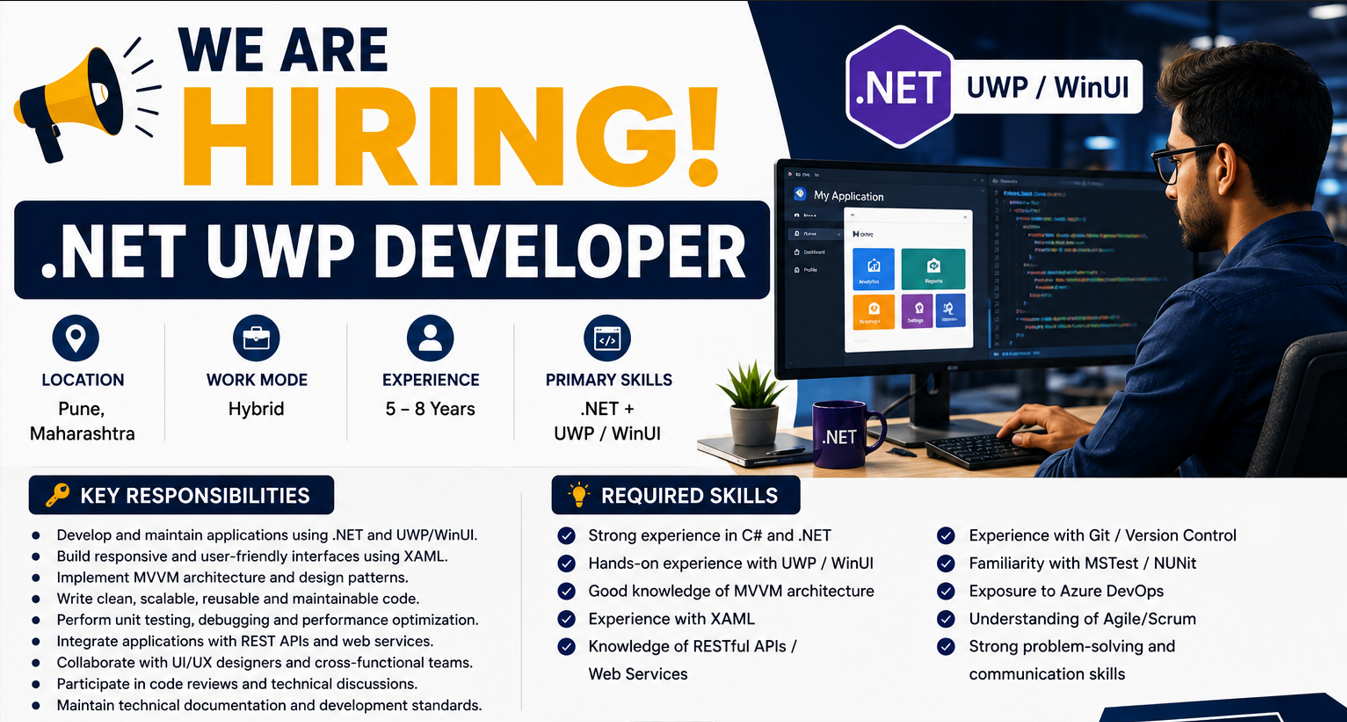
Are you an experienced desktop software engineer skilled in building fluid, enterprise-grade native applications using modern Microsoft client architectures? Cuelogic An LTI Company is actively searching for a talented and analytical Senior .NET UWP Developer to join our engineering division on-site in Pune. This hybrid position is specifically tailored for senior professionals with 5 to 8 years of professional experience who want to design robust user interfaces, manage high-performance desktop clients, and work on bleeding-edge WinUI application modules.
Hiring for Cuelogic An LTI Company.
💼 Position Overview:
• Role: Senior .NET UWP Developer
• Experience Required: 5 - 8 Years of professional desktop application engineering
• Job Location: Hinjewadi Phase 1, Pune, Maharashtra (Hybrid Work Setup - Part Office, Part Home)
• Employment Type: Full-Time, Permanent
• Salary Framework: ₹12,00,000 - ₹18,00,000 Per Annum (Commensurate with architectural expertise)
⚙️ Core Roles & Responsibilities:
As a Senior .NET UWP Developer in our Pune tech center, your daily technical and architectural tasks will include:
• Designing, architecting, and maintaining robust client-side desktop applications using C# and Universal Windows Platform (UWP) frameworks.
• Designing complex, highly responsive, and adaptive application frontends utilizing advanced XAML styling components.
• Implementing clean code architectural standards by strictly adhering to the MVVM (Model-View-ViewModel) design pattern.
• Developing, integrating, and debugging secure integration points with backend systems using RESTful Web APIs.
• Optimizing desktop application execution performance, monitoring memory profiles, and fixing runtime execution bottlenecks.
• Reviewing codebase architecture, troubleshooting complex application exceptions, and maintaining software documentation.
• Collaborating closely with cross-functional design units, backend teams, automated testing QA divisions, and agile product leads.
📌 Technical Skills & Profile Required:
Candidates applying for this senior desktop engineering role must possess advanced expertise in:
• Core Language: Advanced engineering command over C#.NET programming and comprehensive .NET Framework / .NET Core modules.
• Client-Side Ecosystem: Extensive hands-on experience building custom applications utilizing UWP or modern WinUI architectures.
• Layout Architecture: Proficient structural mastery of XAML data-binding configurations, layout properties, and styling behaviors.
• Architectural Design Patterns: In-depth production implementation track records utilizing the MVVM structural pattern framework.
• Integration Layer: Practical experience standardizing data serialization processes and consuming secure RESTful APIs.
• Version Control: Strong source code management habits using Git branching workflows, submodules, and GitHub / GitLab repositories.
• Debugging Capabilities: Advanced analytical diagnostic logic, thread management, memory leak analysis, and crash dump auditing.
Top 10 Advanced UWP & MVVM Interview Q&As (5-8 Years Experience)
To assist senior desktop engineers in successfully clearing our technical evaluation pipeline, our panel has compiled the essential architecture-grade questions:
Q1. How does data-binding memory management operate in UWP when using {Binding} vs {x:Bind}?
Ans. Legacy {Binding} uses runtime reflection which is resource-heavy and processed on the main thread, operating as an Object data type. Modern {x:Bind} compiles at build time, generating strongly-typed native C# code blocks. It defaults to OneTime execution tracking, drastically lowering memory overhead and eliminating reflection-based memory leaks.
Ans. Legacy {Binding} uses runtime reflection which is resource-heavy and processed on the main thread, operating as an Object data type. Modern {x:Bind} compiles at build time, generating strongly-typed native C# code blocks. It defaults to OneTime execution tracking, drastically lowering memory overhead and eliminating reflection-based memory leaks.
Q2. How do you resolve UI freezing issues during heavy background I/O database operations in a UWP app?
Ans. Main thread blocking is avoided by implementing async/await asynchronous tasks. All heavy network processing or file read/write workflows must run inside Task.Run(). To update UI visual layers from background context tasks, you must marshal execution parameters back to the main thread using Windows.ApplicationModel.Core.CoreApplication.MainView.CoreWindow.Dispatcher.RunAsync().
Ans. Main thread blocking is avoided by implementing async/await asynchronous tasks. All heavy network processing or file read/write workflows must run inside Task.Run(). To update UI visual layers from background context tasks, you must marshal execution parameters back to the main thread using Windows.ApplicationModel.Core.CoreApplication.MainView.CoreWindow.Dispatcher.RunAsync().
Q3. Explain the lifecycle states of a Universal Windows Platform (UWP) desktop application.
Ans. A UWP client application navigates through three core lifecycle states managed by the operating system framework: NotRunning, Running, and Suspended. When a user minimizes or switches away, the OS triggers the Suspending event within 5 seconds to freeze computing loops and preserve system memory cells.
Ans. A UWP client application navigates through three core lifecycle states managed by the operating system framework: NotRunning, Running, and Suspended. When a user minimizes or switches away, the OS triggers the Suspending event within 5 seconds to freeze computing loops and preserve system memory cells.
Q4. How do you communicate cleanly between a View and a ViewModel without violating structural decoupling?
Ans. The MVVM architecture strictly prohibits ViewModels from possessing direct structural references to View elements. Decoupled cross-component communication is managed by binding commands via ICommand layouts, mapping structural notifications using the INotifyPropertyChanged interface array, and utilizing Event Aggregators or Messenger services for broadcasting event tokens.
Ans. The MVVM architecture strictly prohibits ViewModels from possessing direct structural references to View elements. Decoupled cross-component communication is managed by binding commands via ICommand layouts, mapping structural notifications using the INotifyPropertyChanged interface array, and utilizing Event Aggregators or Messenger services for broadcasting event tokens.
Q5. How do you implement Dependency Injection (DI) inside a modern UWP/WinUI application?
Ans. DI is set up during application bootstrap routines inside App.xaml.cs configuration hooks. We register services using Microsoft.Extensions.DependencyInjection framework packages. The built-in IServiceProvider container acts as a centralized factory provider to resolve concrete class instances programmatically across clean ViewModel structures.
Ans. DI is set up during application bootstrap routines inside App.xaml.cs configuration hooks. We register services using Microsoft.Extensions.DependencyInjection framework packages. The built-in IServiceProvider container acts as a centralized factory provider to resolve concrete class instances programmatically across clean ViewModel structures.
Q6. What are XAML ResourceDictionaries and how do you utilize MergedDictionaries for scaling styling?
Ans. ResourceDictionaries encapsulate reusable UI components like custom control templates, localized strings, and explicit color themes. For large-scale enterprise clients, styles are separated into modular individual files and consolidated globally inside App.xaml using the <ResourceDictionary.MergedDictionaries> markup block array.
Ans. ResourceDictionaries encapsulate reusable UI components like custom control templates, localized strings, and explicit color themes. For large-scale enterprise clients, styles are separated into modular individual files and consolidated globally inside App.xaml using the <ResourceDictionary.MergedDictionaries> markup block array.
Q7. How do you diagnose and track down severe memory leaks inside an enterprise-scale .NET UWP client?
Ans. Diagnostic logging utilizes advanced diagnostic tools like dotMemory or Visual Studio Diagnostics Hub. We collect snapshot dumps during continuous operations, track down persistent object roots, audit events that lack proper un-subscription patterns, and override Dispose() structures to clear complex event listener registrations.
Ans. Diagnostic logging utilizes advanced diagnostic tools like dotMemory or Visual Studio Diagnostics Hub. We collect snapshot dumps during continuous operations, track down persistent object roots, audit events that lack proper un-subscription patterns, and override Dispose() structures to clear complex event listener registrations.
Q8. What is App Suspension data preservation, and how do you handle OnSuspending overrides?
Ans. When UWP apps transition into a Suspended state, they risk being terminated by the OS to reclaim device memory. In the OnSuspending event handler, developers must implement structural serialization routines to write active user session states, form data strings, and operational navigation stacks into local application storage containers.
Ans. When UWP apps transition into a Suspended state, they risk being terminated by the OS to reclaim device memory. In the OnSuspending event handler, developers must implement structural serialization routines to write active user session states, form data strings, and operational navigation stacks into local application storage containers.
Q9. How do you handle conditional styling logic inside XAML without cluttering backend code-behind scripts?
Ans. Conditional UI layout styling logic is managed natively inside XAML layers by utilizing custom IValueConverter implementations. A class implementing IValueConverter evaluates input data bindings dynamically and returns the target layout parameters (e.g., Visibilities or Color states) back to the visual container block.
Ans. Conditional UI layout styling logic is managed natively inside XAML layers by utilizing custom IValueConverter implementations. A class implementing IValueConverter evaluates input data bindings dynamically and returns the target layout parameters (e.g., Visibilities or Color states) back to the visual container block.
Q10. What is the role of AppX or MSIX packaging architecture inside modern .NET client environments?
Ans. MSIX provides a secure, fully containerized deployment package system for Windows desktop software. It isolates application installations from core OS directories, automates delta-update streaming Command structures, and maps sandboxed storage registries to guarantee clean, zero-leftover uninstallation sequences.
Ans. MSIX provides a secure, fully containerized deployment package system for Windows desktop software. It isolates application installations from core OS directories, automates delta-update streaming Command structures, and maps sandboxed storage registries to guarantee clean, zero-leftover uninstallation sequences.
📋 Selection & Interview Process:
Our structured multi-tier evaluation pipeline for this hybrid senior requirement at Cuelogic involves:
• Phase 1: Technical Resume Screening – Shortlisting based on past client application delivery matrices, portfolio architectures, and UWP system familiarity.
• Phase 2: Architectural Case Study / Coding Task – A time-bound practical programming task analyzing MVVM framework separation, XAML scaling, and clean C# code compilation.
• Phase 3: Technical Interview Panel Deep Dive – An intricate face-to-face evaluation covering asynchronous programming patterns, threading management, memory leaks, and secure API bindings.
• Phase 4: HR & Strategic Closing – Final conversation focusing on hybrid work expectations, workplace culture alignment, compensation package details, and onboarding phases.
🎁 Perks & Benefits:
• Modern Hybrid Autonomy: Strike the ultimate work-life balance with a flexible mixed office and work-from-home scheduling setup in Pune.
• Premium Compensation Matrix: Highly lucrative senior-level salary structures (₹12L - ₹18L PA) that directly mirror your technical expertise.
• Career Progression: Clear opportunities to graduate into technical architecture leadership paths within an expanding global IT team.
📩 How to Apply:
Know an experienced C# desktop engineer with strong UWP and XAML skills looking for a premium hybrid role in Pune? Share this amazing career opportunity with them!