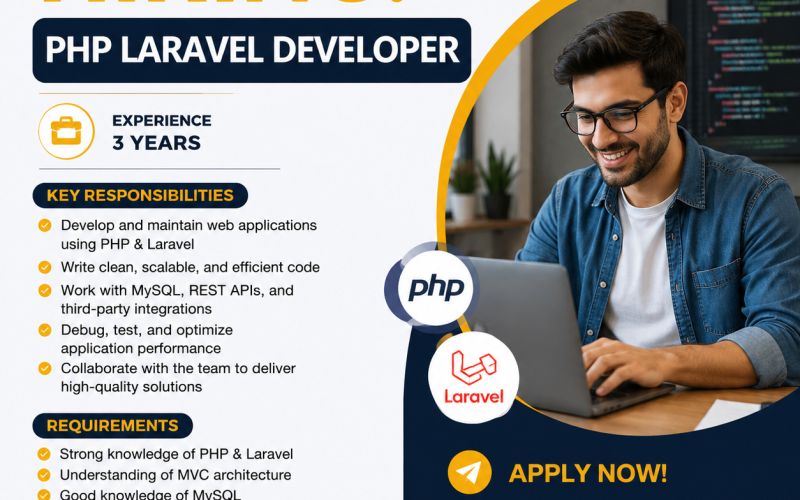
🚀 We're Hiring: Laravel PHP Developer in Noida (Full-Time | 5 Days Working)
• Role: Laravel PHP Developer / Backend Engineer
• Experience Required: 2 - 5 Years of professional software development experience
• Job Location: Sector 63, Noida, Uttar Pradesh (Complete Work From Office)
• Working Days: 5 Days a week (Saturday & Sunday Off)
• Employment Type: Full-Time, Permanent
• Salary Framework: ₹2,40,000 - ₹5,00,000 Per Annum (Fixed brackets based on skill assessment)
As a Laravel PHP Developer at Yes IT Labs, your core day-to-day responsibilities will include:
• Designing, developing, and maintaining robust web applications using PHP Laravel frameworks.
• Writing clean, secure, scalable, and well-documented object-oriented programming (OOPs) code.
• Architecting, optimizing, and managing complex MySQL database schemas, query indexings, and subqueries.
• Building, testing, standardizing, and integrating secure third-party RESTful APIs and microservices.
• Troubleshooting runtime exceptions, monitoring execution latency profiles, and resolving technical software bugs.
• Collaborating closely with client-side front-end developers to integrate user-facing visual elements smoothly.
Candidates applying for this Noida-based framework role must possess the following domain competencies:
• Framework Mastery: Strong practical experience working with the PHP Laravel Framework and MVC software design patterns.
• Core Languages: In-depth knowledge of Core PHP fundamentals and modern object-oriented programming logic.
• Database Management: Good working command over relational databases, specifically structural database normalization and query tuning in MySQL.
• Frontend Basics: Basic conceptual understanding of standard client-side frontend web technologies: HTML5, CSS3, and JavaScript libraries.
• Version Control: Familiarity with source code management pipelines using Git repositories and GitHub versioning workflows.
• Problem Solving: Strong analytical logical reasoning, rapid error troubleshooting habits, and great debugging capabilities.
Top 10 Laravel Interview Questions for Yes IT Labs Noida (2-5 Years Experience)
Q1. What are Queues in Laravel and when should you use them?
Ans. Queues let you move slow work, such as sending emails, generating PDFs or calling third-party APIs, out of the web request and run it in the background. You create a job class that implements ShouldQueue, send it with dispatch(), and a worker started with "php artisan queue:work" processes it. The user gets a fast response, and failed jobs are saved in the failed_jobs table so they can be retried.
Q2. What is Middleware and how have you used it?
Ans. Middleware is a layer that checks or changes a request before it reaches the controller. The built-in "auth" middleware sends guests to the login page. Developers also write custom middleware, for example to block inactive accounts or to allow only admins into a section. It is created with "php artisan make:middleware" and attached to routes or route groups.
Q3. What is Route Model Binding?
Ans. When a route parameter is type-hinted with a model, for example Route::get('/jobs/{job}', ...) with "Job $job" in the controller, Laravel fetches the record automatically and returns a 404 if it does not exist. You can bind by another column, such as a slug, with {job:slug}. This removes repeated findOrFail() code from controllers.
Q4. What is Mass Assignment and how do you protect against it?
Ans. Mass assignment means filling many model fields at once, as in User::create($request->all()). If it is not controlled, a user could send an extra field like "is_admin=1". Laravel protects against this with the $fillable property (a list of allowed fields) or $guarded (a list of blocked fields). Passing only validated data, such as $request->validated(), adds another layer of safety.
Q5. How do Database Transactions work in Laravel?
Ans. DB::transaction() runs a group of queries as a single unit. If any query inside the closure throws an exception, every change is rolled back. This matters when several tables must stay in sync, for example creating an order, reducing stock and saving the payment record together.
Q6. How do you use caching to make a Laravel application faster?
Ans. Cache::remember('key', $seconds, function () { ... }) returns the cached value if it exists. Otherwise it runs the query, stores the result and returns it. This works well for data that is read often and changes rarely, such as category lists or settings. In production, Redis is a common cache driver, and the related cache key should be cleared whenever that data is updated.
Q7. What are Soft Deletes?
Ans. With the SoftDeletes trait and a deleted_at column, calling delete() does not remove the row. It only sets the deleted_at timestamp, and normal queries hide that record automatically. withTrashed() includes deleted records, restore() brings a record back, and forceDelete() removes it permanently. It is useful wherever data must be recoverable or kept for audit history.
Q8. How do you process a very large table without running out of memory?
Ans. Loading lakhs of rows with get() puts all of them in memory at once. chunk(500) loads 500 rows per query and processes them batch by batch, and chunkById() is safer when you are updating the same rows while looping. cursor() or lazy() fetch records one by one using PHP generators, which keeps memory use very low.
Q9. What are API Resources in Laravel?
Ans. An API Resource (a class extending JsonResource) controls exactly how a model is converted to JSON. You choose which fields to return, can rename or format them, and can hide sensitive columns. whenLoaded() includes a relationship only if it was already loaded. This keeps the API response format consistent even if the database structure changes.
Q10. How do you secure an API using Laravel Sanctum?
Ans. Sanctum provides simple token-based authentication for mobile apps and SPAs. After login, $user->createToken('app')->plainTextToken creates a token that the client sends in the Authorization: Bearer header. Routes protected with the auth:sanctum middleware accept only valid tokens. Tokens can be given limited permissions (abilities) and can be revoked at any time.
• Phase 1: Resume Screening – Initial shortlisting based on experience matrices, portfolio quality, and core tech stack match.
• Phase 2: Technical Coding Assignment – A time-bound practical machine coding task to check backend programming logic and database layout design.
• Phase 3: Technical Interview Panel – An in-depth face-to-face deep dive covering Laravel architecture, route filtering protocols, and database normalization.
• Phase 4: HR Round – Final conversation focusing on 5-day work schedule compliance, workplace culture fitment, and formal offer structuring.
• Great Work-Life Balance: Five-day working culture with fixed Saturday & Sunday off periods to recharge.
• Professional Growth: Work closely with senior tech leads on challenging, live custom enterprise-level applications.
• Collaborative Culture: A friendly, highly supportive, collaborative, clean, and technically progressive corporate office workspace.