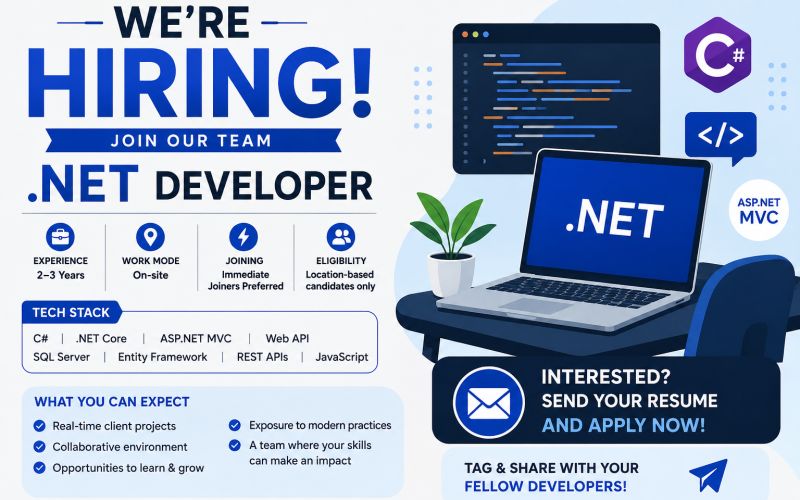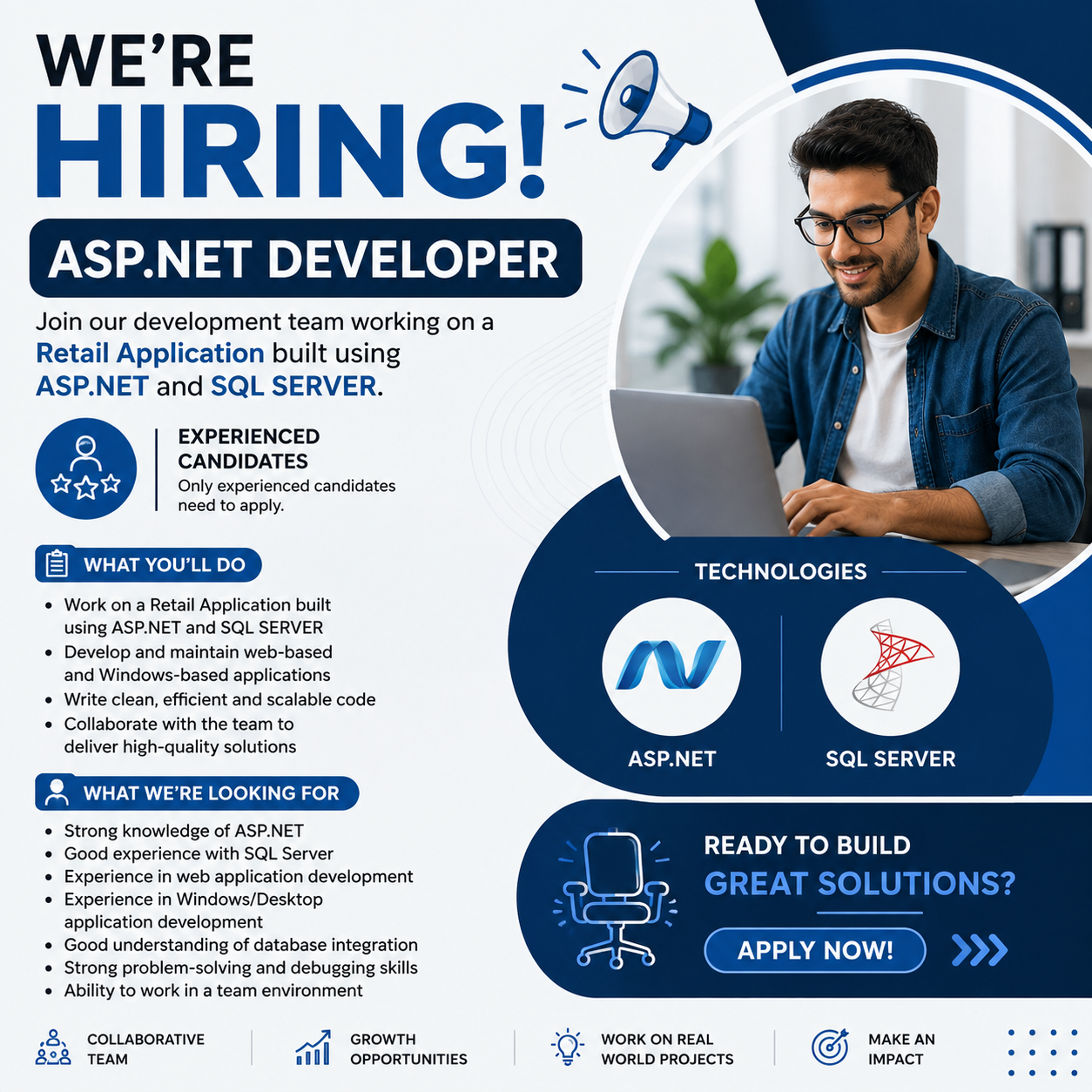
🚀 We're Hiring: ASP.NET Developer (Web & Windows Applications)
Are you an experienced software engineer skilled in building robust enterprise solutions using the Microsoft .NET framework? Dynamic Consultant is actively searching for a talented and logical ASP.NET Developer to join our core engineering team on-site. This unique career opportunity allows you to operate across both high-scale web platforms and secure desktop Windows applications, making it an excellent milestone to showcase your full architectural capabilities.
Hiring for Dynamic Consultant.
💼 Position Overview:
• Role: ASP.NET Developer (Web & Windows Frameworks)
• Experience Required: 2 - 5 Years of professional software development experience
• Job Location: Delhi, India (Complete On-Site / Work From Office)
• Employment Type: Full-Time, Permanent
• Salary Framework: ₹4,80,000 - ₹8,50,000 Per Annum (Based on skill assessment)
⚙️ Core Roles & Responsibilities:
As an ASP.NET Developer at Dynamic Consultant, your daily technical and architectural tasks will include:
• Designing, coding, and maintaining robust web-based applications using ASP.NET MVC / .NET Core architectures.
• Developing, testing, and debugging secure desktop Windows applications using C# and WinForms / WPF modules.
• Architecting, optimizing, and managing secure relational databases using Microsoft SQL Server infrastructure.
• Writing complex SQL queries, stored procedures, triggers, and views for optimal data processing speeds.
• Creating, managing, standardizing, and integrating highly secure RESTful Web APIs and WCF microservices.
• Troubleshooting runtime exceptions, refactoring legacy components, and upgrading legacy desktop frameworks.
• Collaborating closely with front-end UI engineers, QA automated testing teams, and technical project managers.
📌 Technical Skills Required:
Candidates applying for this C# / .NET engineering role must possess practical experience in:
• Core Frameworks: Deep knowledge of .NET Framework, .NET Core, C#.NET, and ASP.NET MVC workflows.
• Desktop Engineering: Practical familiarity with Windows Application development architectures (WinForms or WPF).
• Database Layer: Solid command over MS SQL Server database modeling, indexing, and advanced query optimization.
• Data Access Layers: Working knowledge of Object-Relational Mapping (ORM) tools, specifically Entity Framework or LINQ.
• Front-End Basics: Basic understanding of client-side web elements including HTML5, CSS3, JavaScript, and Bootstrap.
• Source Code Management: Practical exposure to version control practices using Git / GitHub or Azure DevOps tracking.
Top 10 Advanced ASP.NET & Windows Forms Interview Q&As (2-5 Years)
Q1. What is the fundamental difference between building applications in WinForms vs WPF?
Ans. WinForms is a legacy pixel-based framework where UI elements are tightly coupled with the underlying C# logic, rendering via the standard Windows GDI engine. WPF (Windows Presentation Foundation) uses a vector-based layout engine driven by DirectX, separating visual markup natively into XAML sheets while code logic resides inside clean decoupled layers.
Ans. WinForms is a legacy pixel-based framework where UI elements are tightly coupled with the underlying C# logic, rendering via the standard Windows GDI engine. WPF (Windows Presentation Foundation) uses a vector-based layout engine driven by DirectX, separating visual markup natively into XAML sheets while code logic resides inside clean decoupled layers.
Q2. How does data binding inside a Windows desktop app differ from web applications?
Ans. Web application data binding operates statelessly over HTTP request cycles, requiring continuous state management. Desktop clients (UWP, WinForms, WPF) run inside stateful active memory containers, enabling native real-time synchronization through bindings that listen dynamically to model triggers like INotifyPropertyChanged.
Ans. Web application data binding operates statelessly over HTTP request cycles, requiring continuous state management. Desktop clients (UWP, WinForms, WPF) run inside stateful active memory containers, enabling native real-time synchronization through bindings that listen dynamically to model triggers like INotifyPropertyChanged.
Q3. What are stored procedures in SQL Server and why are they preferred over inline SQL?
Ans. Stored procedures are pre-compiled arrays of SQL queries saved inside the database repository. They dramatically reduce execution network latency because their execution plans are cached by the engine, while providing robust security protection arrays that block SQL Injection threats through mandatory parameterization filters.
Ans. Stored procedures are pre-compiled arrays of SQL queries saved inside the database repository. They dramatically reduce execution network latency because their execution plans are cached by the engine, while providing robust security protection arrays that block SQL Injection threats through mandatory parameterization filters.
Q4. Explain the lifecycle steps of an ASP.NET MVC request loop.
Ans. Every HTTP request passes sequentially through a highly structured route extraction phase handled by URL routing modules. Once verified, the MvcHandler initializes target Controller factories, triggers authorization middleware, executes core controller operations, binds data models, and surfaces the final HTML view layout string back to the browser client.
Ans. Every HTTP request passes sequentially through a highly structured route extraction phase handled by URL routing modules. Once verified, the MvcHandler initializes target Controller factories, triggers authorization middleware, executes core controller operations, binds data models, and surfaces the final HTML view layout string back to the browser client.
Q5. What are Database Triggers and what is the strict penalty for overusing them?
Ans. Triggers are automatic specialized transactional SQL blocks executed sequentially when mutation loops (INSERT, UPDATE, DELETE) hit target schemas. Overusing them introduces massive hidden background computing pressures, deadlocks relational data connections, obfuscates system error tracking, and drops transactional latencies.
Ans. Triggers are automatic specialized transactional SQL blocks executed sequentially when mutation loops (INSERT, UPDATE, DELETE) hit target schemas. Overusing them introduces massive hidden background computing pressures, deadlocks relational data connections, obfuscates system error tracking, and drops transactional latencies.
Q6. How do you implement asynchronous multi-threading inside a native Windows desktop client safely?
Ans. Background computations are offloaded from the UI main thread using Task.Run() blocks. To return data or alter structural visual properties on desktop screens without triggering crossing-thread exceptions, background code threads must pass arguments back via centralized marshalling dispatches such as control.Invoke() or CoreDispatcher pipelines.
Ans. Background computations are offloaded from the UI main thread using Task.Run() blocks. To return data or alter structural visual properties on desktop screens without triggering crossing-thread exceptions, background code threads must pass arguments back via centralized marshalling dispatches such as control.Invoke() or CoreDispatcher pipelines.
Q7. What is the purpose of Entity Framework Migrations inside .NET engineering?
Ans. Migrations provide absolute version control capabilities for application database schemas. Instead of manually deploying complex SQL tables across staging or production nodes, developers declare changes programmatically via C# entity classes, enabling continuous synchronization tracking and easy code-based schema rollbacks.
Ans. Migrations provide absolute version control capabilities for application database schemas. Instead of manually deploying complex SQL tables across staging or production nodes, developers declare changes programmatically via C# entity classes, enabling continuous synchronization tracking and easy code-based schema rollbacks.
Q8. What are WCF Services and how do they differ from lightweight RESTful Web APIs?
Ans. WCF (Windows Communication Foundation) is a heavy, SOAP-based enterprise messaging framework that supports complex transport protocols (TCP, Named Pipes, MSMQ) with rigid WS-Security layers. RESTful Web APIs operate entirely over lightweight stateless HTTP protocols transmitting JSON payloads, making them significantly faster and highly scalable for web and mobile frontends.
Ans. WCF (Windows Communication Foundation) is a heavy, SOAP-based enterprise messaging framework that supports complex transport protocols (TCP, Named Pipes, MSMQ) with rigid WS-Security layers. RESTful Web APIs operate entirely over lightweight stateless HTTP protocols transmitting JSON payloads, making them significantly faster and highly scalable for web and mobile frontends.
Q9. How do you identify severe memory leak issues inside long-running C# desktop applications?
Ans. Desktop memory analysis uses profiling utility toolsets like dotMemory or Visual Studio Diagnostics Hub. We audit garbage collection cycles to identify persistent object roots, catch event listeners that lack proper de-registration overrides, and ensure window wrappers isolate system handles cleanly upon closure.
Ans. Desktop memory analysis uses profiling utility toolsets like dotMemory or Visual Studio Diagnostics Hub. We audit garbage collection cycles to identify persistent object roots, catch event listeners that lack proper de-registration overrides, and ensure window wrappers isolate system handles cleanly upon closure.
Q10. What is the role of Dependency Injection lifecycles inside modern ASP.NET Core applications?
Ans. Modern .NET integrates DI natively to enforce loose class coupling. Lifecycles manage runtime object allocations inside three explicit scopes: Transient produces fresh objects on every invocation request; Scoped creates a single object bound valid throughout an individual HTTP loop; Singleton maintains one shared instance across the entire runtime lifecycle.
Ans. Modern .NET integrates DI natively to enforce loose class coupling. Lifecycles manage runtime object allocations inside three explicit scopes: Transient produces fresh objects on every invocation request; Scoped creates a single object bound valid throughout an individual HTTP loop; Singleton maintains one shared instance across the entire runtime lifecycle.
📋 Selection & Interview Process:
• Phase 1: Technical Resume Screening – Shortlisting based on past system delivery matrices and .NET tool competencies.
• Phase 2: Live Machine Coding Test – A practical task analyzing object-oriented programming (OOPs) design, C# logic, and SQL Server query design loops.
• Phase 3: Architectural Deep Dive – A comprehensive technical interview covering MVC routing, desktop threading, memory management, and database normalization.
• Phase 4: HR Discussion – Final conversation regarding structural package expectations, career alignments, and onboarding phases.
🎁 Perks & Benefits:
• Career Progression: Clear milestones and rapid performance appraisal frameworks for dedicated developers.
• Tech Exposure: Deepen your tech skills by owning end-to-end cycles of both web ecosystem architectures and desktop systems.
• Corporate Workspace: Work within a modern, highly supportive, collaborative, and technically progressive development setting.
📩 How to Apply:
Apply via Email Now
Know a skilled Microsoft stack engineer looking for a premium Web and Windows application development job? Share this career opportunity with them!