🚀 We're Hiring: Data Scientist – Machine Learning & MLOps (100% Remote)
Are you an experienced data scientist who loves deploying machine learning algorithms into production frameworks and handling high-scale infrastructure architectures? Sentiaflow is actively searching for a talented and practical Data Scientist specializing in Machine Learning and MLOps to join our distributed engineering division across India. In this critical technical role, you will own the entire lifecycle of enterprise AI models—from exploratory data analytics to scalable real-time cloud deployment.
Hiring for Sentiaflow.
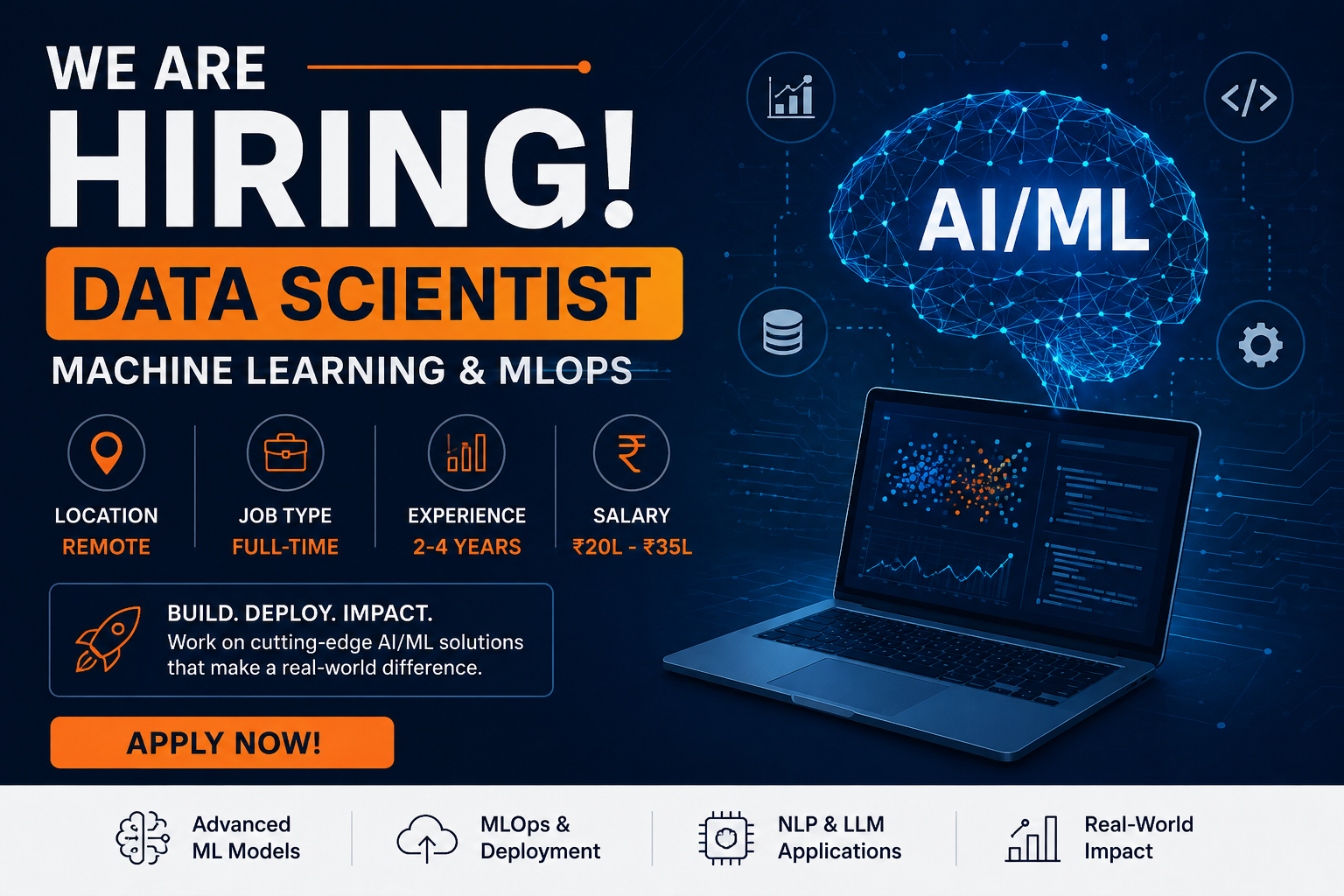
💼 Position Overview:
• Role: Data Scientist – Machine Learning & MLOps
• Experience Required: 2 - 4 Years of industry experience in data science frameworks
• Location: Remote (Work from Anywhere in India)
• Employment Type: Full-Time, Permanent
• Salary Bracket: ₹20,00,000 – ₹35,00,000 LPA (Fixed brackets based on skill assessment)
⚙️ Core Roles & Responsibilities:
As a Remote Data Scientist at Sentiaflow, your daily technical responsibilities will include:
• Designing, training, evaluating, and fine-tuning predictive machine learning and deep learning models.
• Architecting end-to-end MLOps automation pipelines for model training, continuous validation, and version control.
• Structuring complex data preprocessing steps, cleaning pipeline integrations, and extraction queries from relational or unstructured databases.
• Serving models as highly optimized, containerized microservices behind secure RESTful APIs.
• Monitoring production model performance logs to check for concept drift, latency bottlenecks, and reliability issues.
• Collaborating closely with cloud architects and backend engineers to scale model compute clusters efficiently.
📌 Technical Skills & Core Stack Required:
Candidates applying for this engineering role must possess active proficiency in:
• Programming & Analysis: Minimum 2–4 years of hands-on data science experience using Python ecosystem (NumPy, Pandas, Scikit-Learn).
• Deep Learning Frameworks: Strong theoretical and practical foundation in deep learning frameworks (TensorFlow, PyTorch).
• MLOps Infrastructure: Proven production experience building automated pipelines with MLOps infrastructure (MLflow, Kubeflow, or DVC).
• Containerization & Deployment: Solid understanding of software containerization ecosystems using Docker and Kubernetes deployment logic.
• Database Management: Working knowledge of relational databases like MySQL alongside unstructured cloud data structures.
Top 10 Data Science & MLOps Infrastructure Interview Q&As (2–4 Years Experience)
Q1. How do you automate data version tracking inside an agile, collaborative ML pipeline?
Ans. Data tracking utilizes Data Version Control (DVC) tools. Instead of pushing massive binary arrays or multi-gigabyte CSV files directly to Git, DVC serializes dataset states into remote cloud containers like AWS S3 or Azure Blobs. It then generates compact, human-readable identifier tracking files (.dvc strings) that are checked into Git, matching exact dataset history snapshots to specific code versions.
Ans. Data tracking utilizes Data Version Control (DVC) tools. Instead of pushing massive binary arrays or multi-gigabyte CSV files directly to Git, DVC serializes dataset states into remote cloud containers like AWS S3 or Azure Blobs. It then generates compact, human-readable identifier tracking files (.dvc strings) that are checked into Git, matching exact dataset history snapshots to specific code versions.
Q2. What is the difference between Feature Engineering and Feature Selection, and why are they crucial?
Ans. Feature Engineering programmatically creates new mathematical columns or transforms raw values into informative properties (e.g., extracting hour tokens from timestamp fields). Feature Selection utilizes statistical filters or wrapper metrics (like Recursive Feature Elimination) to drop redundant columns, reducing model training memory overhead and preventing overfitting.
Ans. Feature Engineering programmatically creates new mathematical columns or transforms raw values into informative properties (e.g., extracting hour tokens from timestamp fields). Feature Selection utilizes statistical filters or wrapper metrics (like Recursive Feature Elimination) to drop redundant columns, reducing model training memory overhead and preventing overfitting.
Q3. How do you handle severe class imbalance challenges when training predictive classifiers?
Ans. Class imbalance is resolved using structural resampling techniques. We apply algorithmic synthetic sampling methods like SMOTE (Synthetic Minority Over-sampling Technique) to interpolate minority data clusters, enforce asymmetric class weight vectors inside loss functions to penalize minor-class evaluation failures harder, or utilize precise metric evaluation graphs like Precision-Recall AUC instead of simple Accuracy arrays.
Ans. Class imbalance is resolved using structural resampling techniques. We apply algorithmic synthetic sampling methods like SMOTE (Synthetic Minority Over-sampling Technique) to interpolate minority data clusters, enforce asymmetric class weight vectors inside loss functions to penalize minor-class evaluation failures harder, or utilize precise metric evaluation graphs like Precision-Recall AUC instead of simple Accuracy arrays.
Q4. Explain the operational setup required to serve deep learning models with sub-millisecond inference latency.
Ans. Standard web engines introduce heavy parsing latency during forward propagation. We package python model logic into compiled formats like TensorRT or ONNX graphs and deploy them inside specialized inference execution servers like Triton Inference Server or TorchServe, which utilize automated dynamic request batching and concurrent model execution containers.
Ans. Standard web engines introduce heavy parsing latency during forward propagation. We package python model logic into compiled formats like TensorRT or ONNX graphs and deploy them inside specialized inference execution servers like Triton Inference Server or TorchServe, which utilize automated dynamic request batching and concurrent model execution containers.
Q5. What is Concept Drift inside a live production environment, and how do you mitigate it asynchronously?
Ans. Concept Drift occurs when the underlying statistical relationship between the input model parameters and target output labels changes over time due to shifts in external conditions. We build automated verification workers inside tools like Evidently AI or Kubeflow to continuously monitor real-world production logs, track structural Population Stability Index (PSI) fluctuations, and trigger automated retraining cycles when drift thresholds are breached.
Ans. Concept Drift occurs when the underlying statistical relationship between the input model parameters and target output labels changes over time due to shifts in external conditions. We build automated verification workers inside tools like Evidently AI or Kubeflow to continuously monitor real-world production logs, track structural Population Stability Index (PSI) fluctuations, and trigger automated retraining cycles when drift thresholds are breached.
Q6. How do you leverage Docker to bridge the gap between model prototyping and cloud production environments?
Ans. Docker isolates complex local system dependencies, CUDA driver dependencies, and unique Python environment libraries from host environments. By packaging model files, preprocessing parameters, and inference code into a stateless, lightweight image container, we guarantee that model code renders with identical behavioral matrices across staging environments and Kubernetes production nodes.
Ans. Docker isolates complex local system dependencies, CUDA driver dependencies, and unique Python environment libraries from host environments. By packaging model files, preprocessing parameters, and inference code into a stateless, lightweight image container, we guarantee that model code renders with identical behavioral matrices across staging environments and Kubernetes production nodes.
Q7. What is the fundamental difference between L1 (Lasso) and L2 (Ridge) regularization methods?
Ans. L1 Regularization injects absolute weight values into loss optimization functions, forcing negligible feature coefficients down to absolute zero, effectively performing automated feature selection. L2 Regularization adds squared penalty values to constraints, scaling model weight parameters uniformly close to zero to handle multicollinearity without eliminating features completely.
Ans. L1 Regularization injects absolute weight values into loss optimization functions, forcing negligible feature coefficients down to absolute zero, effectively performing automated feature selection. L2 Regularization adds squared penalty values to constraints, scaling model weight parameters uniformly close to zero to handle multicollinearity without eliminating features completely.
Q8. How do you implement continuous integration for machine learning models using MLflow registries?
Ans. When automated validation triggers execute, training scripts output model metrics into centralized MLflow monitoring dashboards. The deployment framework logs model metadata, structures artifacts, and locks dependencies. If testing parameters cross automated threshold gates, the pipeline registers the model code state to a production-ready tag, triggering GitOps release procedures automatically.
Ans. When automated validation triggers execute, training scripts output model metrics into centralized MLflow monitoring dashboards. The deployment framework logs model metadata, structures artifacts, and locks dependencies. If testing parameters cross automated threshold gates, the pipeline registers the model code state to a production-ready tag, triggering GitOps release procedures automatically.
Q9. Explain the execution loop of a Random Forest regressor compared to Gradient Boosting models.
Ans. Random Forest operates on Bagging logic, training multiple independent Decision Trees concurrently in parallel and averaging results to lower system variance. Gradient Boosting runs on Boosting principles, building sequential shallow trees where each new model layer is trained specifically to minimize the residual calculation errors of the immediately preceding tree layout.
Ans. Random Forest operates on Bagging logic, training multiple independent Decision Trees concurrently in parallel and averaging results to lower system variance. Gradient Boosting runs on Boosting principles, building sequential shallow trees where each new model layer is trained specifically to minimize the residual calculation errors of the immediately preceding tree layout.
Q10. How do you structure hyperparameter optimization loops efficiently without bottlenecking cloud costs?
Ans. Random grid-searching across millions of hyperparameter permutations introduces high computational pressure. We implement sequential optimization frameworks like Bayesian Optimization or Optuna. These frameworks utilize Gaussian algorithms to model past evaluation history parameters, predicting the next optimal set of parameter arrays to minimize computation cycles.
Ans. Random grid-searching across millions of hyperparameter permutations introduces high computational pressure. We implement sequential optimization frameworks like Bayesian Optimization or Optuna. These frameworks utilize Gaussian algorithms to model past evaluation history parameters, predicting the next optimal set of parameter arrays to minimize computation cycles.
📋 Selection & Interview Process:
• Phase 1: Portfolio & CV Review – Initial shortlisting based on production deployment history and core tool knowledge.
• Phase 2: Technical Live Coding Round – A practical assignment evaluating database processing efficiency, matrix array data transformations, and ML architecture logic.
• Phase 3: System Design & MLOps Deep Dive – An intricate face-to-face evaluation covering cloud scaling metrics, automated model tracking systems, and container pipelines.
• Phase 4: HR Discussion – Final conversation covering remote compliance criteria, workplace culture alignment, package structures, and onboarding timelines.
🎁 Perks & Benefits:
• Total Workspace Autonomy: Enjoy the complete freedom of a 100% permanent remote work setup from home.
• Competitive Growth Structure: Earn a top-tier premium package (₹20L – ₹35 LPA) matching core international tech benchmarks.
• Cutting-Edge Infrastructure: Work on live, industry-grade production environments using massive data compute resources and cloud clusters.
• Collaborative Network: Engage with senior engineering Leads, data scientists, and progressive tech founders daily.
📩 How to Apply:
Know a fellow engineer who is looking for a premium remote MLOps or Machine Learning job in India? Share this high-paying opportunity with them!