Are you a skilled .NET Developer looking for your next challenge? Our Research and Technology Solutions team (DEP_174) in Noida is growing and looking for permanent, on-site talent.
We need someone who can dive deep into the Microsoft Dot Net ecosystem and build scalable, enterprise-level applications.
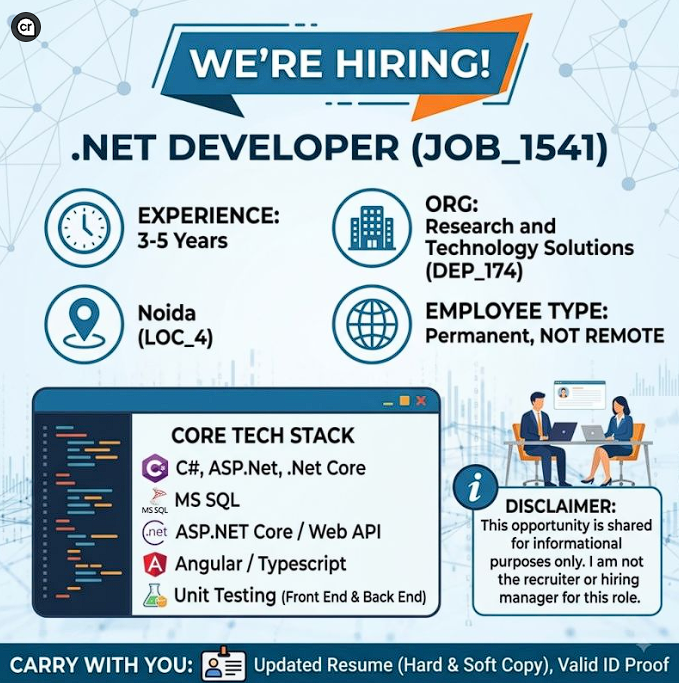
Location: Noida (LOC_4) – Permanent, Non-Remote.
What We Are Looking For:
✅ Experience: 3 - 5 Years working on Microsoft Dot Net based applications.
✅ Backend Mastery: Strong knowledge of OOPS, .Net concepts, C#, ASP.Net, .Net Core, and MS SQL.
✅ API Expertise: Good knowledge of ASP.NET Core framework and Web API concepts.
✅ Frontend Skills: Experience building Enterprise level Front End applications using Angular (Typescript).
✅ Quality Focused: Proven experience in writing unit tests for both Front End and Back End layers.
Important Details:
Job ID: JOB_1541
How to Apply:
Interested candidates, please connect with or send your updated resume to DM:
👤 Rahul Mahato (9574)
#hiring #dotNetDeveloper #NoidaJobs #TechJobs #CSharp #Angular #WebAPI #JobOpening #DeveloperJobs #SoftwareEngineering #ResearchAndTechnology #xceedance
Disclaimer: This opportunity is shared for informational purposes only. I am not the recruiter or hiring manager for this role.
Top 10 .NET Interview Questions & Answers — 5–10 Years Experience
1. What is the difference between .NET Framework and .NET (Core/5/6/7/8+)?
Answer:
.NET Framework is primarily a Windows-based framework used for building applications such as ASP.NET MVC, Web Forms, and Windows applications.
Modern .NET is cross-platform, open-source, and supports Windows, Linux, and macOS. It provides better performance, built-in dependency injection, modern APIs, cloud-native capabilities, and improved support for containers and microservices.
For new applications, modern .NET is generally preferred over the legacy .NET Framework.
2. What is Dependency Injection in .NET, and why is it important?
Answer:
Dependency Injection (DI) is a design pattern where a class receives its dependencies from an external source instead of creating them internally.
For example, instead of creating a repository directly inside a controller:
The dependency is injected through the constructor.
Benefits:
- Loose coupling
- Better unit testing
- Easier maintenance
- Better separation of concerns
- Easier replacement of implementations
In ASP.NET Core, DI is built into the framework.
3. What is the difference between Singleton, Scoped, and Transient services?
Answer:
| Lifetime | Description |
|---|---|
| Transient | Creates a new instance every time it is requested |
| Scoped | Creates one instance per HTTP request |
| Singleton | Creates one instance for the application's entire lifetime |
Example:
A Scoped lifetime is commonly used for services such as Entity Framework DbContext, while Singleton should be used carefully for thread-safe, application-wide services.
4. How do you improve the performance of a .NET Web API?
Answer:
I would first identify the actual bottleneck using logging, profiling, metrics, and database analysis.
Common optimization techniques include:
- Use asynchronous programming with
async/await - Optimize database queries
- Add appropriate database indexes
- Avoid unnecessary
Include()operations - Use pagination
- Use caching where appropriate
- Return only required fields using DTOs
- Avoid unnecessary object allocations
- Enable response compression when appropriate
- Use efficient serialization
- Move long-running operations to background jobs
- Use connection pooling
- Optimize external API calls
For database-heavy APIs, I would also analyze the generated SQL and execution plan rather than optimizing only the C# code.
5. What is the difference between IEnumerable, IQueryable, and List?
Answer:
IEnumerable is generally used for working with data that is already available in memory. LINQ operations are executed locally.
IQueryable is designed for querying data sources such as databases. With Entity Framework, the LINQ expression can be translated into SQL and executed by the database.
List is a concrete in-memory collection that stores the actual data.
Example:
A common mistake is calling ToList() too early. That can cause the entire dataset to be loaded into memory before filtering or projection.
6. How does async/await work in .NET?
Answer:async/await is primarily used for asynchronous operations, especially I/O-bound operations such as:
- Database calls
- HTTP requests
- File operations
- External API calls
Example:
The important point is that async/await does not automatically create a new thread. It allows the application to avoid blocking a thread while waiting for an asynchronous operation to complete.
This is particularly useful in high-concurrency Web APIs.
7. What is Middleware in ASP.NET Core?
Answer:
Middleware is a component in the ASP.NET Core request pipeline that can process HTTP requests and responses.
Examples include:
- Exception handling
- Authentication
- Authorization
- Logging
- CORS
- Request/response processing
A simple middleware can look like:
The order of middleware is important because requests pass through the pipeline in the configured sequence.
8. How do you handle exceptions globally in ASP.NET Core?
Answer:
Instead of putting try-catch blocks in every controller action, I prefer centralized exception handling.
For example, ASP.NET Core provides exception-handling middleware:
For APIs, a custom exception-handling middleware can:
- Catch unhandled exceptions.
- Log the exception.
- Map known exceptions to appropriate HTTP status codes.
- Return a consistent error response.
For production systems, I would also avoid exposing internal exception details to clients.
9. How would you secure a .NET Web API?
Answer:
I would use multiple layers of security.
Important practices include:
- JWT or OAuth 2.0/OpenID Connect for authentication
- Role-based or policy-based authorization
- HTTPS
- Input validation
- Proper authentication and authorization checks
- Parameterized queries / EF Core
- Secure secret management
- Rate limiting where appropriate
- CORS configuration
- Secure HTTP headers
- Proper logging and monitoring
- Avoid exposing sensitive information in API responses
- Regular dependency and security updates
For example:
Authentication confirms who the user is, while authorization determines what the user is allowed to do.
10. How would you design a scalable .NET application for millions of users?
Answer:
For a large-scale application, I would focus on scalability, reliability, performance, and maintainability.
A possible architecture could include:
Depending on the requirements, I would consider:
- Stateless APIs
- Horizontal scaling
- Load balancing
- Redis or distributed caching
- Database indexing and optimization
- Read replicas
- Background processing
- Message queues
- API versioning
- CDN for static content
- Monitoring and centralized logging
- Containerization
- CI/CD pipelines
- Microservices only where they provide a real benefit
The architecture should be based on actual business and scalability requirements rather than adopting microservices unnecessarily.
⭐ Important topics to prepare for 5–10 years experience
Apart from these 10 questions, prepare strongly for:
ASP.NET Core → Web API → Entity Framework Core → LINQ → SQL → Dependency Injection → SOLID → Design Patterns → Authentication/JWT → Microservices → Caching → Redis → Azure/AWS → Docker → CI/CD → Multithreading → Async/Await → Performance Optimization → System Design.