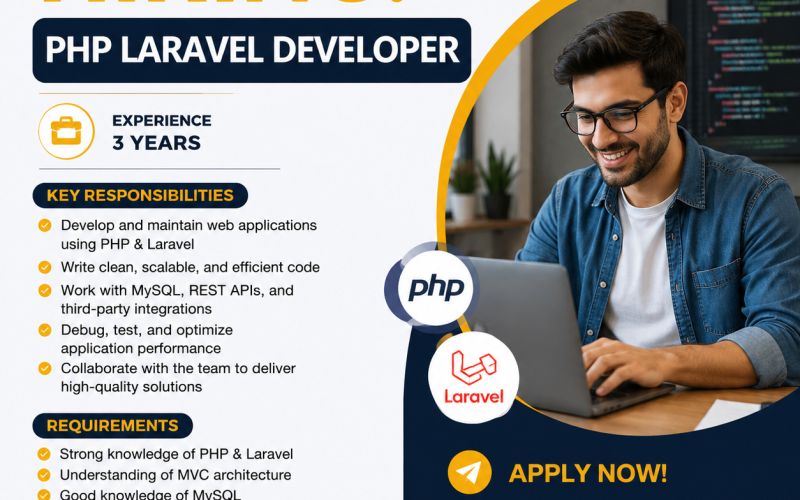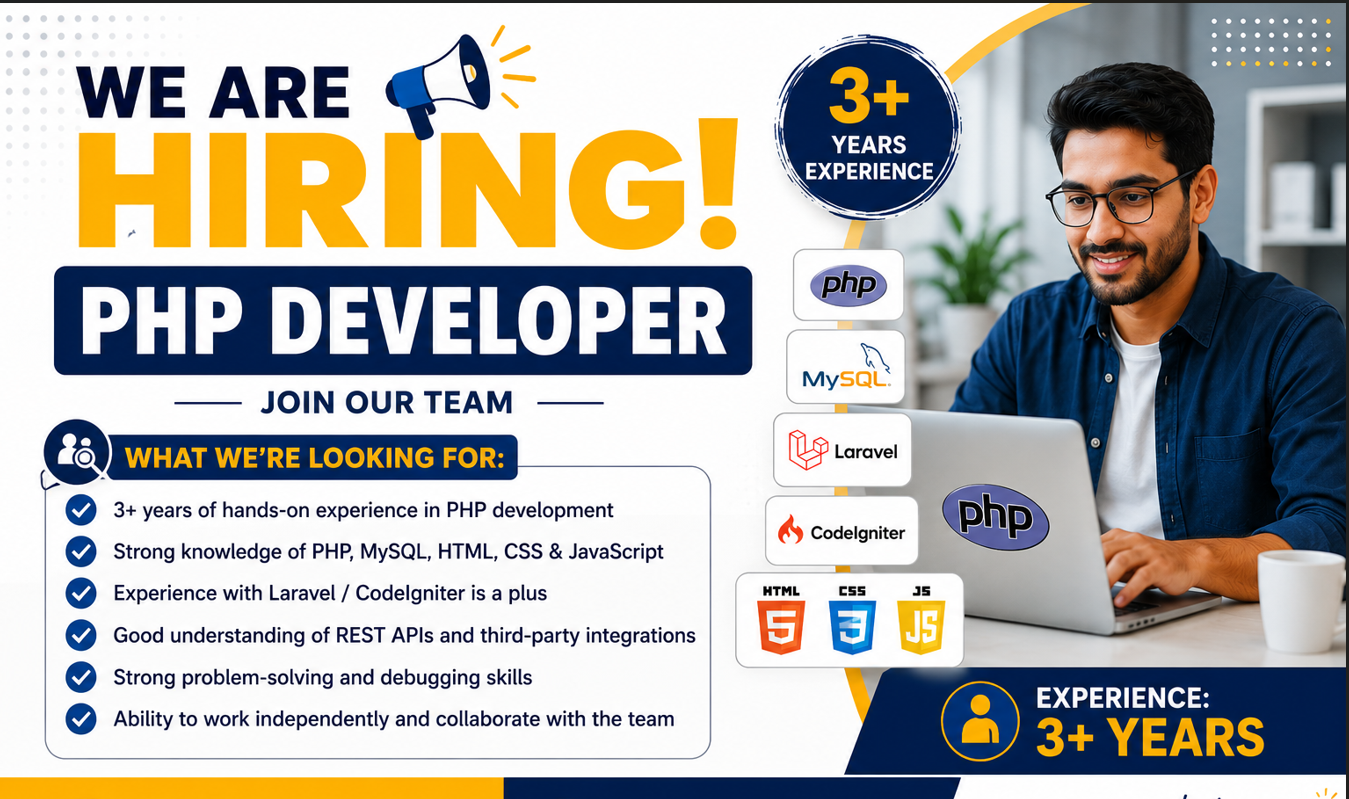
🚀 We're Hiring: Mid-Level PHP Developer (3+ Years Experience)
Are you an experienced backend engineer skilled in crafting scalable server-side systems and robust web architectures? Muxlet is searching for a Mid-Level PHP Developer for a full-time, on-site role offering competitive compensation for professionals with 3+ years of experience.
Hiring For Muxlet.
💼 Position Overview:
• Role: Mid-Level PHP Developer / Backend Engineer
• Experience Required: 3+ Years of professional software production experience
• Job Location: Tech Park Zone, India (On-Site / Work From Office)
• Employment Type: Full-Time, Permanent
• Salary Range: ₹4,50,000 - ₹7,80,000 Per Annum
⚙️ Core Roles & Responsibilities:
• Designing, writing, testing, and maintaining secure server-side logic using Core PHP and frameworks like Laravel or CodeIgniter.
• Architecting relational database structures and optimizing MySQL queries.
• Creating, testing, and integrating secure RESTful Web APIs.
• Troubleshooting runtime exceptions and collaborating with cross-functional engineering teams.
📌 Technical Skills & Profile Required:
• Core PHP and OOPs expertise.
• Hands-on production experience with Laravel or CodeIgniter.
• Strong MySQL database management and API integration skills.
• Familiarity with HTML5, CSS3, JavaScript, Bootstrap, and Git version control.
📋 Selection & Interview Process:
1. Technical CV Evaluation
2. Live Machine Coding Test
3. Technical Interview Panel Deep Dive
4. HR Validation Round
Top 10 Mid-Level PHP & Database Architecture Interview Q&As
Q1. What is the fundamental difference between abstract classes and interfaces in PHP?
Ans. An abstract class can contain a mix of concrete implemented methods and abstract method signatures, supporting single inheritance workflows. An interface can only define empty contract method signatures without any execution body, and a single PHP class can implement multiple interface masks concurrently.
Q2. How do you prevent SQL Injection threats when querying databases manually in Core PHP?
Ans. Instead of embedding raw user input variables directly into SQL query strings, you must utilize Parameterized Queries or Prepared Statements using PDO or MySQLi. This method sanitizes and isolates variables safely before running execution cycles on relational cells.
Q3. What are Traits in PHP, and what specific architectural problem do they solve?
Ans. PHP only supports single inheritance, meaning a class can only extend one parent directory. Traits are specialized compiler mechanisms that contain modular method collections designed to be injected across independent classes, enabling safe code reuse and bypassing the multiple inheritance deadlock.
Q4. How do you optimize query execution speeds for millions of rows inside Microsoft SQL Server or MySQL?
Ans. Database optimization requires targeting physical storage configurations. Implement clustered and non-clustered indexes based on analytical runtime metrics, avoid utilizing wildcard operators or structural 'SELECT *' queries, and replace heavy Table Scans with precise Index Seeks.
Q5. What is the difference between synchronous execution threads and asynchronous Task models?
Ans. Synchronous threads completely halt system thread processing pools while waiting for slow operations like disk files or network card data transfers to finish. Asynchronous execution yields the active thread handle cleanly back to the operating system pool, allowing it to fulfill other request loops.
Q6. Explain the operational difference between Clustered and Non-Clustered Indexes.
Ans. A Clustered Index physically re-orders the actual data rows inside the database table based on the key values (e.g., Primary Key), meaning a table can only possess one clustered layout. A Non-Clustered Index builds a distinct logical mapping array separate from the primary data pages.
Q7. How does JSON Web Token (JWT) authentication operate in modern RESTful Web APIs?
Ans. JWT is a stateless authentication architecture. Upon successful login validation, the server generates a cryptographically signed payload containing three components: Header, Claims Payload, and Signature. Clients transmit this token inside HTTP Authorization headers to gain secure access to endpoints.
Q8. What are the core architectural layout principles governing SOLID programming design?
Ans. SOLID provides a framework pattern blueprint for maintainable codebases: Single Responsibility maps one reason for modification; Open/Closed opens extensions but closes core modification; Liskov Substitution allows child types to replace parents cleanly; Interface Segregation breaks large masks into targeted items; Dependency Inversion maps abstract boundaries.
Q9. How does Object-Eloquent state-tracking differ from non-tracking execution modifiers?
Ans. By default, systems track state modifications on retrieved objects to automatically push runtime updates back to database cells during save loops. Utilizing non-tracking modifiers (like .AsNoTracking()) bypasses this memory-intensive state-tracking container completely, providing a massive speed boost for read-only analytical actions.
Q10. How do you centralized global exception pipelines to capture unexpected application runtime crashes safely?
Ans. Centralized exception capturing is handled using custom middleware chains. Instead of embedding repetitive try-catch architectures into individual controller routes, unhandled crashes are caught at a higher execution layer, keeping production logs private while returning sanitized error blocks to clients.
📩 How to Apply:
Know a skilled backend developer with strong PHP and framework competencies looking for a career upgrade? Share this premium career opportunity with them!