🚀 We're Hiring: PHP & Laravel Developer in Lucknow (Full-Time Opening)
A growing development team is looking for a skilled and motivated PHP & Laravel Developer to join its in-house engineering team in Lucknow. If you are passionate about building scalable web applications, solving complex database problems, and accelerating your tech career under senior technical mentorship, Websofy Computers is actively searching for you! This full-time career opportunity allows you to work on real-world projects while rapidly scaling your professional IT career parameters.
Hiring for Websofy Computers.
💼 Position Overview:
• Role: PHP & Laravel Developer / Backend Engineer
• Experience Required: 2+ Years of professional industry experience
• Job Location: Hazratganj / Vikas Nagar, Lucknow, Uttar Pradesh (Complete On-Site / Work From Office)
• Employment Type: Full-Time, Permanent
• Salary Framework: ₹25,000 - ₹45,000 Per Month (Fixed brackets based on skill assessment)
⚙️ Core Roles & Responsibilities:
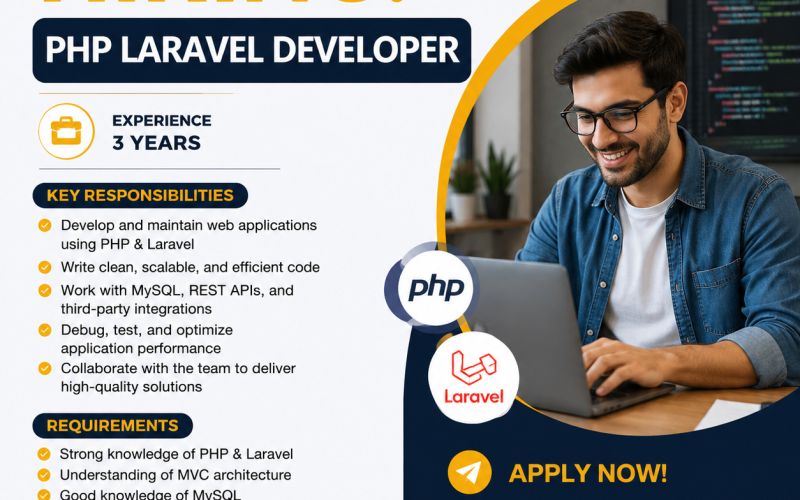
As an experienced PHP/Laravel Developer at Websofy Computers, your daily core responsibilities will include:
• Designing, developing, and maintaining high-performance web applications using Laravel frameworks.
• Writing clean, secure, object-oriented PHP code following industry best programming practices.
• Architecting, optimizing, and managing complex MySQL database queries, indices, and schemas.
• Creating, testing, standardizing, and integrating secure third-party RESTful APIs and microservices.
• Troubleshooting, debugging, and refactoring existing legacy codebases to improve execution speed and reduce latency.
• Collaborating closely with client-side frontend developers and UI/UX designers for smooth application integration.
📌 Technical Skills Required:
Candidates applying for this Lucknow-based position must possess the following domain competencies:
• Backend Engineering: Minimum 2+ years of professional web development experience using Core PHP and the Laravel Framework (MVC architecture).
• Database Management: Solid command over relational databases, specifically structural database normalization, indexing, and query performance tuning in MySQL.
• Frontend Basics: Good understanding of standard client-side frontend technologies including HTML5, CSS3, JavaScript rules, and native jQuery scripting.
• Version Control: Proven experience with source code management workflows using Git repositories and GitHub versioning.
• Problem Solving: Excellent logical debugging, analytical capabilities, and rapid error troubleshooting habits under pressure.
Top 10 Advanced Laravel & MySQL Query Tuning Q&As (2+ Years Experience)
Q1. How do you mitigate the "N+1 query problem" when loading complex relational models in Laravel Eloquent?
Ans. The N+1 query problem occurs when lazy-loading relationships inside a collection loop, triggering individual database calls for each row record. We resolve this by enforcing Eager Loading via the with() helper method, fetching parent and child records concurrently inside a single optimized SQL execution loop.
Ans. The N+1 query problem occurs when lazy-loading relationships inside a collection loop, triggering individual database calls for each row record. We resolve this by enforcing Eager Loading via the with() helper method, fetching parent and child records concurrently inside a single optimized SQL execution loop.
Q2. What are database migrations inside Laravel, and how do they benefit staging deployments?
Ans. Migrations act like structural version control for your database layout schemas. Instead of manually running raw SQL files across deployment environments, developers write modular PHP classes to programmatically construct or alter database cells, ensuring team alignment and easy migration rollbacks.
Ans. Migrations act like structural version control for your database layout schemas. Instead of manually running raw SQL files across deployment environments, developers write modular PHP classes to programmatically construct or alter database cells, ensuring team alignment and easy migration rollbacks.
Q3. What is the Service Container and how does it execute dependency management?
Ans. The Service Container is a powerful automated framework tool design container used to manage class dependencies and execute Dependency Injection (DI) natively. Classes declare interface parameters they require, and the engine automatically instantiates and injects concrete classes at runtime.
Ans. The Service Container is a powerful automated framework tool design container used to manage class dependencies and execute Dependency Injection (DI) natively. Classes declare interface parameters they require, and the engine automatically instantiates and injects concrete classes at runtime.
Q4. Explain the execution pipeline difference between Laravel Gates and Policy abstraction modules.
Ans. Gates are abstract, closure-based permission checks registered globally inside service providers, best suited for generic standalone application actions (e.g., viewing an admin dashboard). Policies are object arrays tightly coupled to specific Eloquent models to manage granular CRUD resource validation.
Ans. Gates are abstract, closure-based permission checks registered globally inside service providers, best suited for generic standalone application actions (e.g., viewing an admin dashboard). Policies are object arrays tightly coupled to specific Eloquent models to manage granular CRUD resource validation.
Q5. How does the automated CSRF token verification process intercept cross-site request forgery attacks?
Ans. The global VerifyCsrfToken middleware chain tracks all incoming POST, PUT, and DELETE HTTP verbs. It parses incoming header data parameters to match encrypted payload tokens against current verified user session states, automatically blocking unauthorized third-party automated request manipulation.
Ans. The global VerifyCsrfToken middleware chain tracks all incoming POST, PUT, and DELETE HTTP verbs. It parses incoming header data parameters to match encrypted payload tokens against current verified user session states, automatically blocking unauthorized third-party automated request manipulation.
Q6. Explain the operational difference between the database relationships belongsTo() and hasMany().
Ans. hasMany() defines a one-to-many relationship mapped inside a parent model directory pointing to multiple child records (e.g., a Author hasMany books). belongsTo() maps the inverse structure inside the child model using foreign keys to point back to its specific unique parent node.
Ans. hasMany() defines a one-to-many relationship mapped inside a parent model directory pointing to multiple child records (e.g., a Author hasMany books). belongsTo() maps the inverse structure inside the child model using foreign keys to point back to its specific unique parent node.
Q7. How do you handle application runtime configuration data safely inside a Laravel framework?
Ans. All environment variables, API secret access keys, and system database passwords must be stored securely inside the root directory
Ans. All environment variables, API secret access keys, and system database passwords must be stored securely inside the root directory
.env configuration file, which should never be pushed to public source control systems like GitHub to prevent security leaks.Q8. What are Laravel Seeders and Database Factories used for?
Ans. Seeders are technical utility modules used to populate database cells programmatically with static data configuration templates. Factories use advanced faker libraries to automate the bulk generation of millions of rows of dummy records for rapid machine runtime performance testing.
Ans. Seeders are technical utility modules used to populate database cells programmatically with static data configuration templates. Factories use advanced faker libraries to automate the bulk generation of millions of rows of dummy records for rapid machine runtime performance testing.
Q9. What is the fundamental difference between the PUT and PATCH HTTP request methods?
Ans. PUT is used to execute a complete overwrite replacement of an entire resource object entity block, requiring a complete layout model mapping payload. PATCH transmits small localized modification parameters to update specific target fields inside database cells without disturbing adjacent properties.
Ans. PUT is used to execute a complete overwrite replacement of an entire resource object entity block, requiring a complete layout model mapping payload. PATCH transmits small localized modification parameters to update specific target fields inside database cells without disturbing adjacent properties.
Q10. How do you optimize heavy raw MySQL queries inside a Laravel database connection loop?
Ans. Optimization targets storage and reading layout layers. Utilize indexed select arrays instead of wildcard queries, avoid complex subquery strings inside heavy rendering loops, regularize structural indexing patterns on columns inside WHERE logs, and cache results safely using Redis.
Ans. Optimization targets storage and reading layout layers. Utilize indexed select arrays instead of wildcard queries, avoid complex subquery strings inside heavy rendering loops, regularize structural indexing patterns on columns inside WHERE logs, and cache results safely using Redis.
📋 Selection & Interview Process:
• Phase 1: Resume Screening – Initial shortlisting based on experience parameters, portfolio structures, and core tech stack match.
• Phase 2: Technical Coding Test – A time-bound practical machine coding assignment to check core backend programming logic and database joins.
• Phase 3: Technical Interview Panel – An in-depth face-to-face deep dive covering MVC architecture routing, API configurations, and database optimization constraints.
• Phase 4: HR Round – Final strategic conversation focusing on workspace culture fitment, formal package alignment, and onboarding timelines.
🎁 Perks & Benefits:
• Career Progression: Rapid performance-based evaluation tracks and fast career progression milestones for dedicated backend engineers.
• Skill Enrichment: Work directly on complex multi-tenant enterprise application configurations supervised directly by senior tech leads.
• Professional Environment: Enjoy a friendly, highly supportive, collaborative, clean corporate culture with modern office infrastructure.
📩 How to Apply:
Know a fellow backend developer who is looking for a Laravel job in Lucknow? Share this career opportunity with them!