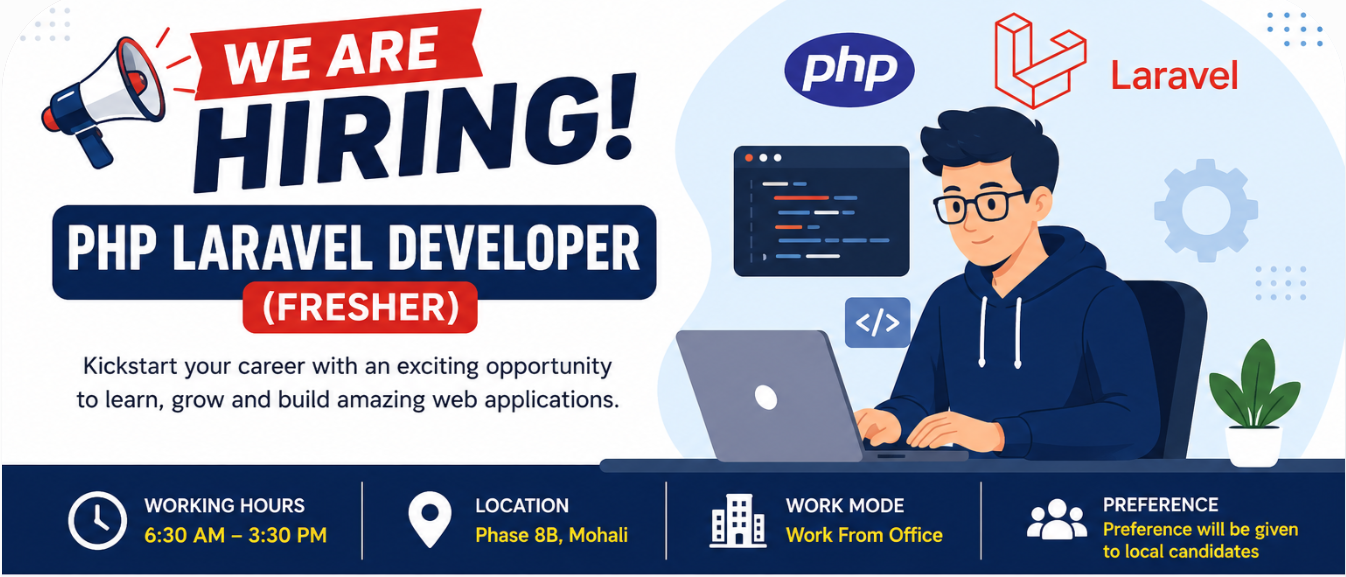
🚀 We're Hiring: PHP Laravel Developer – Fresher Vacancy (Mohali)
Are you an ambitious tech graduate looking to launch your software engineering career by building dynamic, modern web applications, optimizing relational databases, and mastering MVC structures? IDS Infotech Ltd is actively searching for motivated, driven, and enthusiastic PHP Laravel Developer Freshers to join our expanding in-house engineering division on-site in Phase 8B, Mohali. This entry-level full-time position is an exceptional career milestone for candidates who have recently completed formal technical training or an internship and want to work on active live enterprise projects under senior technical mentorship.
Hiring for IDS Infotech Ltd.
💼 Position Overview:
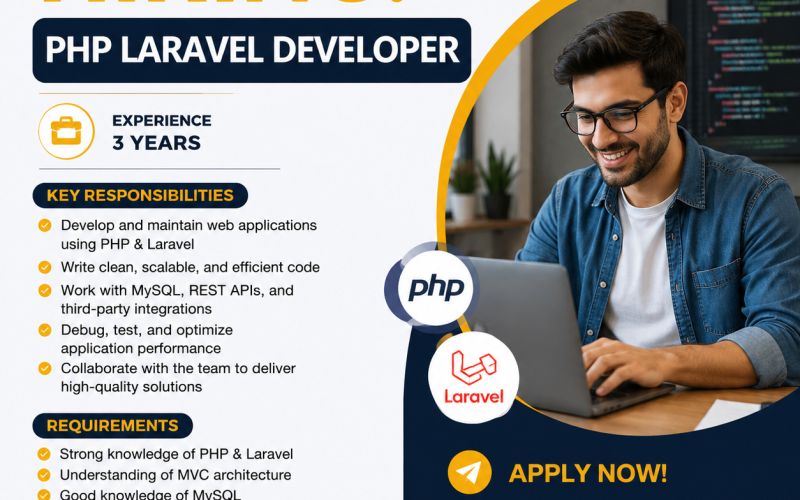
• Role: PHP Laravel Developer (Fresher / Associate Level)
• Experience Required: 0 - 1 Years (Candidates with formal PHP/Laravel training or internships are highly preferred)
• Job Location: Phase 8B, Industrial Area, Mohali, Punjab (Complete On-Site / Work From Office)
• Working Shift Hours: 6:30 AM – 3:30 PM (Early Morning Shift Compliance Required)
• Employment Type: Full-Time, Permanent
• Salary Framework: ₹15,000 - ₹28,000 / month (Based on machine coding performance)
⚙️ Core Roles & Responsibilities:
As a Fresher PHP Laravel Developer in our Mohali technical center, your daily execution targets will include:
• Assisting senior backend engineers in writing clean, well-structured, and maintainable object-oriented PHP code scripts.
• Developing, updating, testing, and maintaining modular server-side components using the Laravel framework ecosystem parameters.
• Writing, debugging, and optimizing basic relational database schemas, structural tables, and standard MySQL queries.
• Building, testing, standardizing, and documenting internal RESTful APIs for frontend client layout integration architectures.
• Integrating responsive frontend elements (HTML5, CSS3, JavaScript tools) smoothly with core backend application logic components.
• Troubleshooting minor application bugs, tracking syntax execution errors, and resolving software runtime exceptions.
• Participating actively in technical sprint meetings, structural agile trainings, and adopting modern deployment pipelines quickly.
📌 Technical Skills & Profile Required:
Candidates applying for this Mohali-based fresher opening must possess basic domain competencies in:
• Framework Ecosystem: Foundational understanding of Core PHP fundamentals, object-oriented programming (OOPs), and the Model-View-Controller (MVC) architecture.
• Database Management: Basic query structural writing, table relation handling, foreign key constraints, and storage patterns utilizing MySQL databases.
• Client-Side Layouts: Good conceptual understanding of standard client-side web tools including HTML5, CSS3, and JavaScript libraries.
• Responsive Toolkit: Functional familiarity mapping responsive UI styling attributes utilizing Bootstrap frameworks.
• Version Control Basics: Elementary knowledge of source code management pipelines using Git repositories and GitHub versioning workflows.
• Mindset Profile: Quick logical debugging aptitude, strong analytical approach, and a high desire for continuous tech upgrades under pressure.
Top 10 PHP Laravel Interview Q&As for Freshers (Mohali Drive)
To help junior candidates successfully clear the technical screening rounds, our engineering backend leads have compiled the essential framework questions:
Q1. What is the significance of MVC architecture inside the Laravel framework?
Ans. MVC splits application configurations into three logical layers: Models manage data rules and database schema loops; Views handle the final frontend HTML/CSS visual render layouts; Controllers act as a broker to filter requests, process backend business logic, and bind models with views.
Q3. Explain the difference between Query Builder and Eloquent ORM in Laravel execution loops.
Ans. Query Builder runs highly performant native SQL database structures directly via PDO parameterization wrappers, which is extremely fast. Eloquent ORM is an advanced Active-Record implementation that maps database tables to custom PHP object classes, making data manipulation incredibly clean but slightly heavier on server memory.
Q4. What is Middleware in Laravel, and what is its primary execution purpose?
Ans. Middleware represents specialized interceptor code chains injected into the application's routing pipeline. They validate, alter, or block incoming HTTP requests before they reach core controller actions (e.g., executing user authentication validation checks or setting up global CORS rules).
Q6. Explain the operational difference between the database relationships belongsTo() and hasMany().
Ans. hasMany() defines a one-to-many relationship mapped inside a parent model directory pointing to multiple child records (e.g., a Company hasMany developers). belongsTo() maps the inverse structure inside the child model using foreign keys to point back to its specific unique parent node.
Q7. How do you pass dynamic variable arrays from a routing file into a Blade template view layout?
Ans. Variables are injected into blade parameters using the native view() function paired with either the with() chain helper or the standard compact() reference token payload configuration block. Example: return view('').
Q9. What is the fundamental difference between the PUT and PATCH HTTP request methods?
Ans. PUT is used to execute a complete overwrite replacement of an entire resource object entity block, requiring a complete layout model mapping payload. PATCH transmits small localized modification parameters to update specific target fields inside database cells without disturbing adjacent properties.
Q10. How do you handle application runtime configuration data safely inside a Laravel framework?
Ans. All environment variables, API secret access keys, and system database passwords must be stored securely inside the root directory the environment file in the project root configuration file, which should never be pushed to public source control systems like GitHub.
📋 Selection & Interview Process:
Our structured fresher recruitment pipeline for this backend software role at IDS Infotech Ltd involves:
• Phase 1: Technical CV Evaluation – Screening profiles based on completed training certifications, academic projects, or internship history matrices.
• Phase 2: Core Programming Aptitude Test – A time-bound practical machine coding task analyzing basic PHP logic, array manipulation, and database layouts.
• Phase 3: Technical Interview Panel Deep Dive – An in-depth face-to-face evaluation covering MVC configuration rules, routing parameters, and database query logic loops.
• Phase 4: HR & Shift Alignment Closing – Final conversation focusing on early morning shift compliance (6:30 AM – 3:30 PM), company workspace policies, and formal offer structuring.
🎁 Perks & Benefits:
• Professional Mentorship: Excellent workplace learning curve supervised directly by seasoned software architects and enterprise tech leads.
• Unique Working Hours: Early morning shift (6:30 AM – 3:30 PM) allows you to enjoy a highly productive day, optimize lifestyle layouts, and completely avoid heavy traffic hours.
• Structured Appraisals: Regular performance review milestones and rapid career progression paths for self-driven junior software engineers.
📩 How to Apply:
Know a fresher looking to secure their first full-time PHP Laravel job with excellent learning prospects in Mohali? Share this career opportunity with them!