🚀 OvSofts Hiring: Remote PHP Developer (Full-Time Opening)
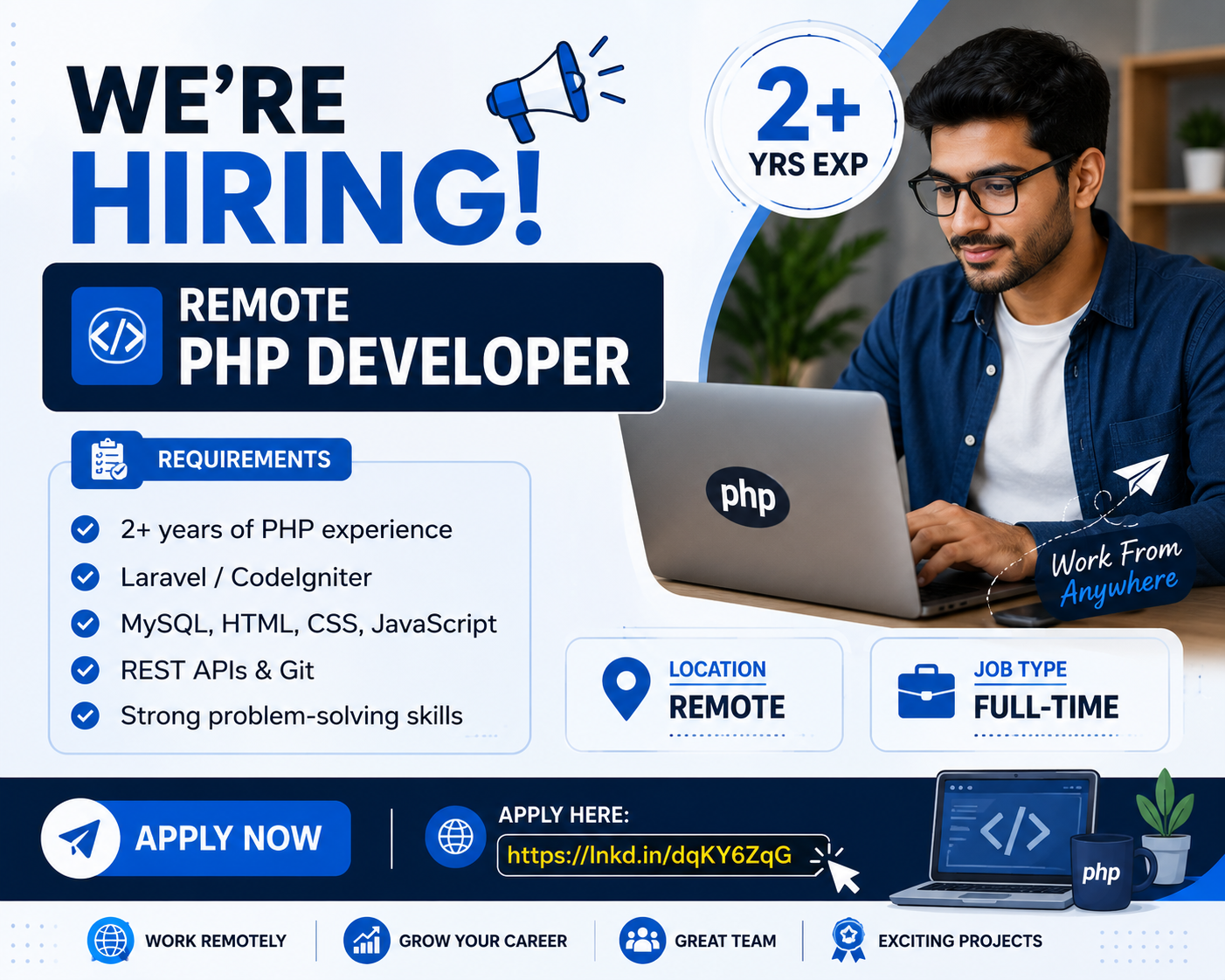
• Role: Remote PHP Developer / Backend Engineer
• Experience Required: 2+ Years of professional web development experience
• Job Location: Lucknow, Uttar Pradesh / 100% Remote (Permanent Work From Home across India)
• Employment Type: Full-Time, Permanent
• Salary Framework: ₹15,000 - ₹20,000 / month (Fixed brackets based on skill assessment tests)
As a Remote PHP Developer at OvSofts, your daily technical and collaborative tasks will include:
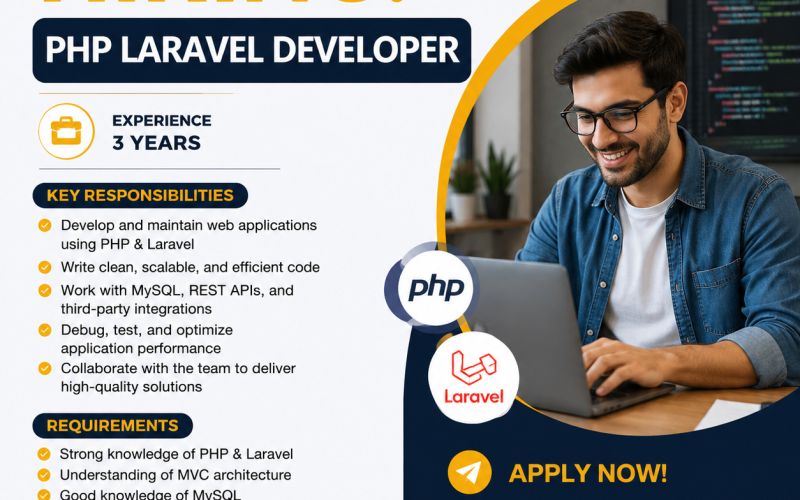
• Designing, developing, testing, and maintaining robust, secure, and clean server-side web applications using PHP frameworks.
• Writing clean, scalable, modular, and well-documented object-oriented programming (OOPs) code scripts following industry best practices.
• Architecting, designing, normalizing, and optimizing complex MySQL database queries, data schemas, and relational indexes for maximum speed.
• Building, testing, standardizing, consuming, and documenting highly secure third-party RESTful APIs and microservices.
• Troubleshooting complex runtime exceptions, monitoring execution latency profiles, debugging bottlenecks, and refactoring existing legacy codebases.
• Collaborating closely with remote frontend client-side developers, UI/UX designers, and product managers for smooth application asset integration.
Candidates applying for this remote software position must possess active proficiency in:
• Core Programming: Minimum 2+ years of professional web development experience using Core PHP and object-oriented programming (OOPs) logic.
• Framework Mastery: Strong practical production-level experience working with either the Laravel Framework or CodeIgniter configurations (MVC patterns).
• Database Layer: Solid command over relational databases, specifically structural database normalization, index parameters optimization, and query performance tuning in MySQL.
• Client-Side Basics: Good conceptual understanding of standard client-side frontend web tools including HTML5, CSS3, JavaScript rules, and native jQuery scripting.
• Version Control: Proven experience with source code management workflows utilizing Git repositories and GitHub versioning pipelines.
Top 10 Core PHP & Remote Backend Interview Questions
Q1. What is the difference between == and === in PHP, and what changed in PHP 8?
Ans. == compares values after converting types, while === checks both value and type. PHP 8 changed some comparisons, so 0 == "abc" is now false. To avoid subtle bugs, prefer === and enable declare(strict_types=1); in your files.
Q2. How does PHP handle pass-by-value and pass-by-reference?
Ans. By default, values are passed as copies, but PHP uses copy-on-write, so the actual copy is made only when the value is modified. Adding & makes a function change the original variable. Objects are passed as handles, so changing an object’s properties inside a function also changes it outside.
Q3. Why should composer.lock be committed, and what is PSR-4 autoloading?
Ans. composer.lock makes every developer and server install the exact same package versions. PSR-4 maps a namespace to a folder path (for example, App\Services to app/Services), so classes load automatically without manual require statements.
Q4. How should passwords be stored in a database?
Ans. Never store plain text, MD5 or SHA1. Use password_hash($password, PASSWORD_DEFAULT) to create the hash and password_verify() at login. It adds a salt automatically, and password_needs_rehash() lets you upgrade old hashes over time.
Q5. How would you process a CSV with millions of rows without running out of memory?
Ans. Instead of loading the whole file into an array, read it with a generator (yield) that returns one row at a time. Memory use stays almost constant, and this pattern works well with fgetcsv().
Q6. How do you make a file upload feature secure?
Ans. Don’t trust the file extension alone. Check the MIME type on the server, limit the file size, and generate a random file name. Store uploads outside the web root, or in a folder where PHP execution is disabled.
Q7. What is the difference between self:: and static:: (Late Static Binding)?
Ans. self:: always refers to the class where the code is written. static:: resolves at runtime to the class that was actually called, so child class overrides work correctly. It is useful in factory and singleton patterns.
Q8. What is the difference between Exception and Error in PHP, and how can you catch both?
Ans. Since PHP 7, both implement the Throwable interface. Exception is meant for application-level problems, while Error covers engine-level problems such as TypeError. You can catch both with catch (Throwable $e), and use finally for cleanup.
Q9. What roles do OPcache and PHP-FPM play in production performance?
Ans. OPcache keeps compiled bytecode in memory, so scripts are not parsed again on every request. PHP-FPM manages a pool of worker processes, which you tune with settings like pm.max_children based on the server’s available RAM.
Q10. When do you use the 401, 403 and 422 status codes in a REST API?
Ans. Use 401 when the user is not authenticated (a missing or invalid token). Use 403 when the user is logged in but lacks permission. Use 422 when the request is understood but fails validation. Correct status codes make debugging much easier for frontend developers and API consumers.
• Phase 1: Technical CV Evaluation – Shortlisting based on past system delivery matrices, project scale history, and core tech stack match.
• Phase 2: Live Machine Coding Assignment – A time-bound practical programming task to check backend programming logic, array manipulation, and database query design loops.
• Phase 3: Technical Interview Panel Deep Dive – An intricatevertual evaluation covering MVC architecture routing, custom API security protocols, and relational database constraints.
• Phase 4: HR Validation Round – Final strategic conversation focusing on remote home workspace compliance, culture alignment, package structuring, and onboarding timelines.
• Total Workspace Autonomy: Enjoy the complete lifestyle freedom of a 100% permanent remote work setup from home.
• Fast-Track Appraisals: Regular performance evaluation milestones and rapid career progression appraisal pathways for dedicated engineers.
• Flexible Working Environment: Focus squarely on system architecture delivery, modern tech frameworks, and rapid career enhancement.